Author Archive

Reflection: Tuesday of the 33rd Week

November 17, 2009

Mass: Tuesday, November 17, 2009
First Reading: 2 Mc 6:18-31
Responsorial Psalm: Ps 3:2-3, 4-5, 6-7
Gospel: Lk 19:1-10

In keeping with this week’s theme of how our daily scriptures connect with the movie industry, we are given a simple message based on the lives of two leading actors: Eleazar and Zacchaeus.

In the first reading, we find Eleazar, the 90-year old scribe, given the opportunity to escape the death penalty by eating pork—thus demonstrating loyalty to the king and renouncing his own religion. Instead of escaping the death sentence, Eleazar remained faithful to the practices of his religion and, because of his faith, was tortured and killed.

What compelled Eleazar do to such a thing?

In the Gospel, we find Zacchaeus, the wealthy, chief tax collector of Jericho, climbing a tree to get Jesus’ attention while passing by. When Jesus tells Zacchaeus that he will dine at his house, Zacchaeus announces publicly, “I’ll give half of all my possessions to the poor and repay back anyone who I extorted money from 4x as much!”

What compelled Zacchaeus to do such a thing?

Indeed, Eleazar and Zacchaeus are powerful central figures in their respective ‘movies.’ Both performed extraordinary acts by taking a leap of faith. Inspired by their examples, we, too, can be asked the same question: What compels us to do extraordinary things on a daily basis—such as dedicating our lives to the service of Mary’s mission? What fuels our efforts to do the best we can with limited resources? What encourages us when the challenges of life become burdensome and difficult?

Like Eleazar and Zacchaeus, may what compels us to do extraordinary things on a daily basis be our response—through our words and actions—to the many blessings that God gives us.

Reflection: Tuesday of the 31st Week

November 3, 2009

Mass: Tuesday, November 3, 2009
First Reading: Rom 12:5-16ab
Responsorial Psalm: Ps 131:1bcde, 2, 3
Gospel: Lk 14:15-24

Sam Bowie. Kwame Brown. Ryan Leaf. What do they have in common? And what do they have to do with today’s scriptures?

For those who aren’t familiar with NBA or NFL trivia, here are some clues. Sam Bowie was selected as the No. 2 NBA draft pick in 1984 by the Portland Trailblazers who passed on Michael Jordan, Charles Barkley and John Stockton—three of the top 50 NBA players of all-time. Sam Bowie played in 10 injury-filled years in the NBA but was never selected as an all-star nor won a championship.

Kwame Brown was the No. 1 pick in the 2001 NBA draft, selected ahead of all-stars Pau Gasol (who won a championship with the Lakers this past summer), Tony Parker (who has three NBA rings, an NBA Finals MVP and Eva Longoria) and Gilbert Arenas (who is considered an all-star and franchise player with the Washington Wizards). Kwame Brown today is a backup for the Detroit Pistons.

Ryan Leaf, the Washington State quarterback who led the Cougars to the Rose Bowl for the first time in over 70 years was selected No. 2 in the 1998 NFL draft ahead of Charles Woodson, Randy Moss and a dozen other Pro-Bowlers. His career lasted only four years, marked by injuries, poor performance and  poor relationship with his teammates.

These three are considered as the three of the biggest draft busts in NBA and NFL history. Great talent in college and high school, loads of potential but unfortunate situations hampered their careers.

So what do they have to do with today’s readings?

The scriptures remind us today of our giftedness—blessed by God who freely gives us not only the gift of peace as stated in the responsorial psalm, but also individual gifts and talents to make a positive impact on our world.

The lesson in today’s Gospel reminds us that while God blesses us with numerous gifts, it is up to us to take action. Unlike those who make excuses and refuse to attend the dinner they were invited to, we are called to develop our gifts and make a positive impact on our world with our unique contributions.

This new day gives us another opportunity to do this by sharing a simple and kind gesture to others; offering an affirming remark; working to be the best student we can be in our classes; striving to be the best mentor or teacher in our classrooms; and being a brother to all whom we meet today.

Reflection: Our Lady of the Pillar

October 12, 2009

2009-10-12-pillar

Mass: Feast of Our Lady of the Pillar
First Reading: 1 Chronicles 15:3-4,15-16;16:1-2
Gospel: Luke 11:27-28

Reflection
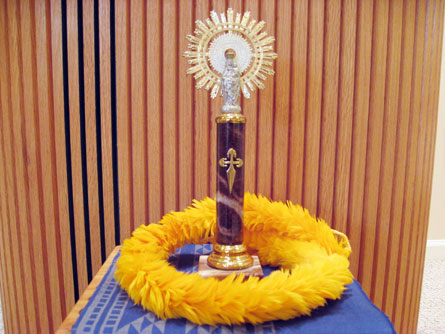
About 200 years ago, France was in the middle of a revolutionary war. The focus of the conflict was a struggle of power between politics, government and religion. By virtue of being a Roman Catholic priest, Blessed Chaminade was forced out of France and exiled to Spain. He arrived on the evening of October 11, 1897 in time to witness the vigil celebration of Our Lady of the Pillar in Zaragosa.

Over the next few years, while waiting to return home to France, Blessed Chaminade spent a lot of time in prayer at the basilica of Our Lady of the Pillar; it was there that he received a vision from God through Mary.

Although the exact nature of that vision never was revealed in detail, it resulted in the founding of the Marianist Family—the Lay Marianists, Sisters and Brothers / Priests.

While 200 years and a different country may seem far away from us here today, our world is quite similar to that of revoluationary France in the late 1800s. We don’t need to read too far into the current news headlines to find that our world is in need of healing.

So, what can we do, in our own little ways, to help our world in need of healing? Blessed Chaminade’s mission was clear and it involved two parts: 1) the salvation of souls and 2) to build communities centered in faith.

The idea behind the first part—the salvation of souls—echoes that of today’s first reading where the ark of the covenant, a container of God, is to be revered and considered as sacred. Just as we are created in God’s image, we, too, are reminded that we are loved by God and containers of Christ.

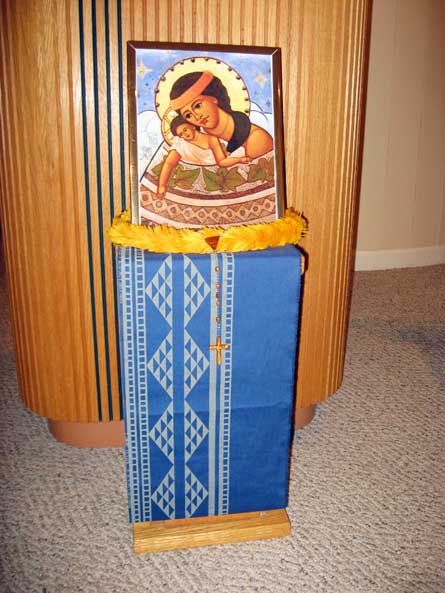
This sacred respect for the soul present in the human body is reflected in the Hawaiian concept of Aloha. Aloha is more than just a greeting or farewell; aloha is also translated as love, affection, mercy, grace. It also is combined from two other words—‘alo’ (face) and ‘hā’ (breath, which contains one’s sacred spirit and soul). So when greeting one another in Hawai‘i, an embrace and exchange of ‘hā’ is the true meaning of aloha—a way of recognizing and respecting the life force, God’s spirit, within whomever we encounter.

The idea behind the second part—community—echoes that of the Gospel. “Blessed are those who hear the word of God and observe it.” As valuable as our faith is to us, it is not meant to be kept to ourselves; it is meant to be shared; this means to give the gift of our talents, our selves and our charism to one another as our response to God’s love for us.

In our zeal to share this charism, I think the biggest temptation we need to be aware of is that of doubt, disappointment and discouragement. When we doubt our abilities, when we think we aren’t good enough or talented enough, when we are discouraged because we don’t perceive results from our efforts—that’s the greatest sin because it goes against our mission of “glorifying God in all places through the Immaculate Virgin Mary.”

It has been said that the Marianist charism seems to be the Church’s “best kept secret.” In some ways, I can understand the thought behind that statement, although I find myself thinking that our way of life is too good to be kept a secret. Just in this chapel alone, I believe we have more than enough talent, creativity and energy to share this with others and not keep it the “Church’s best kept secret.” And that’s why, as different as we are, we come together in community to share in our common mission as Marianists.

So, as we prepare to receive the eucharist, let us pray in gratitude for our Marianist vocation, the vision that Blessed Chaminade passed on to us, and for the strength to be faithful to our mission of “glorifying God in all places through the Immaculate Virgin Mary. Amen.”

Reflection: Our Lady of the Rosary

October 7, 2009

2009-10-07-casa-rosary-reflection

Memorial, October 7

Mass
First Reading: Jon 4:1-11
Responsorial: Ps 86:3-4, 5-6, 9-10
Gospel: Lk 11:1-4

Reflection
I had a hard time choosing between the readings of the day and the memorial of Our Lady of the Rosary. On one hand, following the saga of Jonah always makes for an interesting read and, on the other, listening to Mary’s vocation unfold in scripture is one that is always special to us as Marianists.

At the start of Mass, I went with the readings of the day because that guarantees I get to talk about Jonah as well as Mary!

As outside observers listening to his story, we discover that Jonah has an interesting story. He is quite a character who is called by God and tries to do what God asks of him. However, along the way,  he seems to get distracted and lose focus.

Instead of going to Nineveh, he runs away. He survives an incredible, three day ordeal of being swallowed by a fish. He finally does what God asks in Nineveh and, because of his efforts, the people repent! Yet, Jonah is displeased, becomes angry and wishes for death!

Jonah is such a human character and, in many ways, I can see myself in his actions. In my zeal to do God’s work, the reality of our inevitable humanity and shortcoming makes me question God’s presence. I sometimes lose focus of God’s love around me amid the challenges of daily life.

So, how do we focus on God’s love in the presence of our world’s imperfections? Today’s readings and memorial offer us an answer: Prayer.

There are many methods of prayer: The Rosary, the Our Father (which is the Gospel of the day), music, spiritual reading, meditation, faith-sharing, chanting psalms, etc. Despite these many ways to pray, Blessed Chaminade reminds us that there are few people of prayer.

One way to become people of prayer is to take to heart the following quotes:

“forgive our sins as we forgive others.” As C.S. Lewis once said, “we all believe that forgiveness is a beautiful concept, until we have to practice it.”

“Lord, treat me tomorrow as I treat others today.” — Whoah, that really holds us accountable to our actions!

“I am the servant of the Lord. Let it be done to me according to your word.” From the Gospel of today’s memorial, we hear the example of Mary who, despite the fact that she did not know the entirety of her vocation and where that would lead, said, “Yes.”

Mary faced several challenges in her vocation and, like Jonah, may have wanted to run away. But because of her faith, she remained focused on God’s promise and serves as an example for us to follow.

As we continue our celebration of the memorial of Our Lady of the Rosary, let us call on Mary to intercede for us as we grow to become her other Christs—Sons of Mary for the salvation of souls.

I had a hard time choosing between the readings of the day and the memorial of Our Lady of the Rosary. On one hand, following the saga of Jonah always makes for an interesting read and, on the other, listening to Mary’s vocation unfold in scripture is one that is always special to us as Marianists.
At the start of Mass, I went with the readings of the day because that guarantees I get to talk about Jonah as well as Mary!
As outside observers listening to his story, we discover that Jonah has an interesting story. He is quite a character who is called by God and tries to do what God asks of him. However, along the way,  he seems to get distracted and lose focus.
Instead of going to Nineveh, he runs away. He survives an incredible, three day ordeal of being swallowed by a fish. He finally does what God asks in Nineveh and, because of his efforts, the people repent! Yet, Jonah is displeased, becomes angry and wishes for death!
Jonah is such a human character and, in many ways, I can see myself in his actions. In my zeal to do God’s work, the reality of our inevitable humanity and shortcoming makes me question God’s presence. I sometimes lose focus of God’s love around me amid the challenges of daily life.
So, how do we focus on God’s love in the presence of our world’s imperfections? Today’s readings and memorial offer us an answer: Prayer.
There are many methods of prayer: The Rosary, the Our Father (which is the Gospel of the day), music, spiritual reading, meditation, faith-sharing, chanting psalms, etc. Despite these many ways to pray, Blessed Chaminade reminds us that there are few people of prayer.
One way to become people of prayer is to take to heart the following quotes:
“forgive our sins as we forgive others.” As C.S. Lewis once said, “we all believe that forgiveness is a beautiful concept, until we have to practice it.”
“Lord, treat me tomorrow as I treat others today.” — Whoah, that really holds us accountable to our actions!
“I am the servant of the Lord. Let it be done to me according to your word.” From the Gospel of today’s memorial, we hear the example of Mary who, despite the fact that she did not know the entirety of her vocation and where that would lead, said, “Yes.”
Mary faced several challenges in her vocation and, like Jonah, may have wanted to run away. But because of her faith, she remained focused on God’s promise and serves as an example for us to follow.
As we continue our celebration of the memorial of Our Lady of the Rosary, let us call on Mary to intercede for us as we grow to become her other Christs—Sons of Mary for the salvation of souls.a

Reflection: Our Lady of Sorrows

September 15, 2009

Memorial, September 15

Mass
First Reading: 1 Tm 3:1-13
Responsorial: Ps 101:1b-2ab, 2cd-3ab, 5, 6
Gospel: Lk 2:33-35

Reflection
It seems highly appropriate after celebrating the Exaltation of the Holy Cross, the Church follows that with a Marian Feast, Our Lady of Sorrows, as it reflects Mary’s close presence in the life of her son, Jesus.

This memorial, formerly known as the “Seven Sorrows of Mary”, includes many options for scripture: the first reading from the memorial or of the day; the “Stabat Mater” sequence; and the Gospel from either the scene at Calvary or Simeon’s prophecy.

Like the symbol of the Cross, Mary’s entire life was a sign of contradiction: becoming pregnant out of wedlock; becoming mother and daughter to God; becoming homeless at the time of her child’s birth; becoming a refugee to flee her own country; becoming a parent who outlives her child; becoming mother to all when her son dies; becoming a model of faith to witness that the resurrection—and not death—has the final word.

In many ways, our lives as Marianist religious are signs of contradiction: through our vow of poverty, we become rich in sharing the greatest treasure in our lives: God; through our vow of chastity, we learn the lifelong lesson of giving and receiving unconditional love; through our vow of obedience, we learn the importance of listening and mutual discernment of God’s call; and through our lives in community, we discover the person God wants us to become.

A personalized addendum to Timothy’s letter could speak about the role of a professed Marianist religious: Marianists, too, will become a sign of contradiction to the world; bound by their evangelical vows of poverty, chastity, obedience and stability, they are faithful to Mary’s mission of leading others to Christ.

As we begin our day and prepare to receive the Eucharist, let us pray for the strength to become faithful signs of contradiction in our world and share the joy of our Marianist charism with all whom we meet today.

Reflection: Mary, Queen of Apostles (memorial)

September 5, 2009
Between mid-August to mid-September, the Church calendar features five Marian feasts: Assumption (August 15), Queenship of Mary (August 22), Queen of Apostles (September 5), Nativity of Mary (September 8), Holy Name of Mary (September 12) and Our Lady of Sorrows (September 15).
Although the Society of Mary traditionally observes October 2, 1817 as its foundation, Chaminade considered September 5 to be “foundational” because, on this date in 1818, at the conclusion of a retreat, a handful of men professed vows to the society.
Who would have thought that 191 years later, in a different part of the globe, we would be gathered as members of the Society of Mary to witness something similar: the Rite of Acceptance of two of our newest members of our Province, receiving them officially as aspirants to our community?
What would Blessed Chaminade say about this? Borrowing the word that Provincial Steve Glodek used during the 125th celebration of Marianist presence in Hawai`i, Blessed Chaminade would be “astounded!”
He would be astounded by the collection of diverse stories that brought each of us here to south central Texas. He would be astounded by the 48 page document that outlines the strategic plan for our future as a province in the U.S. He would be astounded by the advances in technology that allows our world to connect instantaneously with one another and a community to experiment with an online community annal. But, most of all, I think he would be astounded by the numbers of men and women who have dedicated their lives to the vision of this “little French priest.”
Blessed Chaminade identified today’s Gospel passage as the moment of our birth as Marianists. We identify ourselves as John, the disciple, who stands at the foot of cross to hear the dying request of Jesus: to take care of Mary and for her to take her of us.
What this implies for us is that we have a big responsibility: to take into our hearts all that Mary stands for–total trust in the Lord, a model of faith, openness to the mysteries of our vocation wherever that might lead–and sharing that with others.
I’d like to conclude with an oli pule, Hawaiian prayer chant. It’s a version of the Three O’Clock Prayer that I was encouraged to write while on my perpetual vow retreat this summer.
E ka Haku Iesu Karisto,
Ma këia hola o ka `auinalä
E hui pü käkou i ka pu`uwai a me ka na`au
E ho`omana`o i ka manawa o kö mäkou hänau
ma Calvary, ke make `oe ma ke ke`a
Ua hä`awi mai i kou makuahine, `o Malia
E piha iä mäkou me ke aloha o ka `Uhane Hemolele
no laila, e ho`ohanohano i kau noi
a e ho`omau me ka mana`o`i`o, ka hau`oli a me ka le`ale`a
i ke kökua `ana i ka mikiona o Malia
e hö`ike i ke aloha i ka honua.
Lord Jesus,
At this hour of the afternoon
We reunite ourselves in heart and spirit
to commemorate the moment of our birth to Mary—-
at Calvary, as you were dying on the cross
you gave us Mary, your mother, to be our own.
Fill us with the grace of the Holy Spirit
that we may honor your request
and persevere faithfully in joy and happiness
as we assist Mary in her mission
of bringing forth aloha in our world.

Saturday, September 5, 2009

First Reading: Acts 1:12-14; 2:1-4
Responsorial Psalm 87:1-2, 3 and 5, 6-7
Gospel: John 19:25-27

Pop Quiz! Category—Church calendar trivia:

Between mid-August to mid-September, the Church celebrates which five Marian feasts?
Answer: Assumption (August 15), Queenship of Mary (August 22), Queen of Apostles (September 5), Nativity of Mary (September 8), Holy Name of Mary (September 12) and Our Lady of Sorrows (September 15).

Although the Society of Mary traditionally observes October 2, 1817 as its foundation, Chaminade considered September 5 to be “foundational” because, on this date in 1818, at the conclusion of a retreat, a handful of men professed vows to the society.

Who would have thought that 191 years later, in a different part of the globe, we would be gathered as members of the Society of Mary to witness something similar: the Rite of Acceptance of two of our newest members of our Province, receiving them officially as aspirants to our community?

What would Blessed Chaminade say about this? Borrowing the word that Provincial Steve Glodek used during the 125th celebration of Marianist presence in Hawai‘i, Blessed Chaminade would be “astounded!”

He would be astounded by the collection of diverse stories that brought each of us here to south central Texas. He would be astounded by the 48 page document that outlines the strategic plan for our future as a province in the U.S. He would be astounded by the advances in technology that allows our world to connect instantaneously with one another and a community to experiment with an online community annal. But, most of all, I think he would be astounded by the numbers of men and women who have dedicated their lives to the vision of this “little French priest.”

Blessed Chaminade identified today’s Gospel passage as the moment of our birth as Marianists. We identify ourselves as the beloved disciple who stands at the foot of the cross to hear the dying request of Jesus: to take care of Mary and for her to take her of us.

What this implies for us is that we have a big responsibility: to take into our hearts all that Mary stands for—total trust in the Lord, a model of faith, openness to the mysteries of our vocation wherever that might lead—and sharing that with others.

I’d like to conclude with an oli pule, Hawaiian prayer chant. It’s a version of the Three O’Clock Prayer that I was encouraged to write while on my perpetual vow retreat this summer.

E ka Haku Iesu Karisto,
Ma kēia hola o ka ‘auinalā
E hui pū kākou i ka pu‘uwai a me ka na‘au
E ho‘omana‘o i ka manawa o kō mākou hānau—
ma Calvary, ke make ‘oe ma ke ke‘a
Ua hā‘awi mai i kou makuahine, ‘o Malia
E piha iā mākou me ke aloha o ka ‘Uhane Hemolele
no laila, e ho‘ohanohano i kau noi
a e ho‘omau me ka mana‘o‘i‘o, ka hau‘oli a me ka le‘ale‘a
i ke kōkua ‘ana i ka mikiona o Malia
e hō‘ike i ke aloha i ka honua. ‘Amene.

Lord Jesus,
At this hour of the afternoon
We reunite ourselves in heart and spirit
to commemorate the moment of our birth to Mary—
at Calvary, as you were dying on the cross
you gave us Mary, your mother, to be our own.
Fill us with the grace of the Holy Spirit
that we may honor your request
and persevere faithfully in joy and happiness
as we assist Mary in her mission
of bringing forth aloha in our world. Amen.
Reflection: The Queenship of Mary (Memorial)

August 22, 2009
First Reading: Ru 2:1-3, 8-11; 4:13-17
Responsorial Psalm 128: How Blessed Are You (Mondoy)
Gospel Acclamation: (Mondoy)
Gospel: Mt 23:1-12

Saturday, August 22, 2009

First Reading: Is 9:1-6
Responsorial: Psalm 113
Gospel: Lk 1:26-38

Pope Piux XII established this feast in 1954, explaining that Mary is deserving of the title as “Queen” because of her special roles as Mother of God and the New Eve of Jesus’ mission as well as for her sinless state and intercessory power.

As members of a religious order that bears her name, we, as Marianists, share in a unique and special relationship with her that distinguishes us from any other group in the Church.

The theme of our Province retreats this past summer focused on Mary, allowing for opportunities to walk and pray with her during significant moments in her life: the Annunciation, Cana, the foot of the cross and Pentecost.

When reflecting on Mary’s own vocational call and how her faith journey unfolded, it is easy to realize the weight of challenges that God placed on her. Depite being born without sin, she remained faithful after making the initial commitment without knowing much about what it will entail or where it will lead (Kathleen Norris, Amazing Grace: A Vocabulary of Faith, 1998, p. 77).

Mary had to deal with the following: having a child out of wedlock; being a parent to God; watching her child become a political enemy and being executed in the most humiliating way in public despite his innocence. Through it all, she remained a model of faith and perseverance not only for us, but for the entire Church.

The opportunities of that retreat have helped me develop a stronger relationship with Mary. During these busy and hectic days, I’ve felt overwhelmed, tired and challenged. I’ve found myself calling on Mary to help me stay focused on my own relationship with God.

I would agree with Pope Pius the XII that Mary is most deserving of the title because of her exceptional qualities. As in Chess, the Queen is the most powerful character in the entire game; likewise, Mary is the most powerful intercessor we could have in our life, particularly as Marianists.

As we gather around the altar, let us reflect on what Chaminade once said: if we allow Mary to take possession of our hearts, we are able to reflect her tenderness and love to share with others. After all, Mary chose each one of us first and it is through the grace of providence that we chose the Society of Mary to live our religious vocation (Retreat of 1817. Notes of M. Lalanne, The Founders Thought V, 20.7-8).