Author Archive

Reflection: Presentation of the Lord

February 2, 2010

Mass: Tuesday, February 2, 2010
First Reading: Mal 3:1-4
Responsorial Psalm 24:7, 8, 9, 10
Second Reading: Heb 2:14-18
Gospel: Lk 2:22-40

February 2nd is a date that holds significant meaning for many throughout history. Despite the rich diversity of stories and events associated with this day, they all have one thing in common. Let’s see if you can figure what that is.

Imagine what it must be like for a young, teenaged girl to have her whole world turned upside down in the past year with the following experiences: being visited by a ghost who predicted many extraordinary things that are starting to come true; gotten pregnant out of wedlock knowing that is punishable by stoning; almost got dumped by her fiancee; finally got married while keeping the pregnancy secret to the public; setting out on a difficult road trip while about to give birth; finally having the child in a stink, smelly barn; having stranger visiting you and wanting to see your child—although some did bring wonderful gifts, which isn’t all that bad!; having to get up and move out of harms way; and now bringing this child to the temple, only to be told by an old man that more challenges await.

What keeps Mary going? What keeps her faithful? True, she has the big advantage of being born without sin, but what about Joseph? Imagine what he must be going through watching this unfold.

Perhaps there are enough lights of hope through all these difficulties—the visitation of the angel; the brightest star guiding the way; the affirmation of three kings and now these wisdom figures at the temple.

Fast forward several hundred years to the middle ages and another scene related to this date. We are now in eastern Europe. It is the dead of winter. Dark and stormy. No lights or electricity. At Church, beeswax candles are blessed and sent home and placed in the windows to ward off the storm and light up the home throughout the year. After all, it’s the feast known as Candlemas. Notice, once again, the symbol of light as protection, faith and hope.

Jump a few hundred years to 1801 in Bordeaux, France. A little French priest named William Joseph witnesses the commitment of a dozen lay people to the vision of Church as given to him by the Blessed Mother just a few years ago while on exile in Saragossa, Spain.

Although province directories and liturgy guides were yet to be invented, I imagine that light and candles were involved, somehow, as they professed their commitments to the Marianist way of life. Imagine what Chaminade must have felt as the candles were lit on this day—when only four years ago, he was banished from his own country on account of his faith.

We move a few years later, mid-1800s, into the new world, across the Atlantic ocean, to the United States. It is a cold, dark morning in the northeast. You awaken, wondering to yourself how much longer this cold, dark weather will last. You vaguely hear voices outside calling your name. As you rouse yourself out of bed, you see a faint glow of light. Excitedly, you run outside to see it is finally, a sunny day. All of a sudden, you see your shadow and run back inside your house. Unfortunately, there will be no early spring this year! You are Punxsutawney Phil, and the light of the sun is an important part of your life.

Finally, we move about 200 more years into the future, to south-central Texas—San Antonio, to be exact. We are gathered here at Mass in Casa Maria. The candle with the Marianist logo is lit, and it says, “The Marianist Flame: Pass it on.”

We are given the gift of a new day and another opportunity to be messengers of light. Fueled by the eucharist we are about to receive, let us pray that we use this day to honor the spirit of our founder’s vision by being and bringing Christ, the light of the world, to others.
Reflection: 3rd Tuesday; Sts. Timothy and Titus

January 26, 2010

Mass: Tuesday, January 26, 2010
First Reading: 2 Tm 1:1-8
Responsorial: Psalm 96:1-2a, 2b-3, 7-8a, 1
Gospel: Mk 3:31-35

When celebrating Mass on the day when the lives of saints are commemorated, the Church, in all her wisdom, strives to incorporate the best of all worlds—and today is a perfect example.

Today is the feast of Sts. Timothy and Titus which adds a number of options to choose from when selecting scriptures for Mass. As suggested in Living with Christ, today’s readings are drawn from the 3rd Tuesday in Ordinary Time as well as the Saint’s feast.

As expected when such an event happens, a unique combination of scripture results. For those who prepare daily reflections, this presents an interesting challenge that compels one to discover the hidden wisdom that we can reflect on and apply to our daily lives.

So, here’s one possible perspective…

In the first reading, Paul affirms Timothy’s faith as passed to him by his grandmother, Lois, and mother, Eunice. The other option for today’s first reading—Paul’s letter to Titus—includes the phrase, “Titus, my true child in our common faith.”

In the Gospel, Jesus states that those who do the will of God and are his family—mother, brother and sister.

Perhaps this combination of scripture reveals a theme about who we are and how our actions define that identity.

Not only do we take on the name of Christians, we also are Marianists—specifically, Marianist religious brothers. So what does it mean to be a “brother to all people”? How does this identity compel us to action?

An obvious area where we serve as a brother to all is in our public ministries. It’s easier to see how we serve as brothers in ministry together at our various institutions. We, like many who have done before us in our rich history, excel in our ministries, do great work, are committed to the mission, and are hard-working professionals—wonderful examples of selfless giving to our world.

When we come home, we are spent! But, we are reminded that when we come home, our role as brother doesn’t stop when we leave our ministry. Our gifts of presence, patience and openness to one another  is need much more here in our home.

I often wondered why the theme for our province assembly in 2007 was “Becoming Brothers.” For a religious congregation who professes that community life, discipleship of equals and mixed composition are sacred values, becoming “brothers” to one another is expected to be a reality. Or, perhaps it is because that becoming “brothers” to one another in community can be one of the most difficult challenges of religious life that requires a lifetime of faithfulness in seeking that goal.

We are blessed with numerous gifts, talents and personalities. Our diversity is rich. Yet, it is that same diversity that challenges us to be faithful to our identity of being a community of “brothers” to one another in one heart and mind.

Doing the little things for one another is what makes for good community. Trusting that we will be present for one another at prayer, work, play, community and calling each one of us to be more than we think we can become supports one another in being faithful.

Let us pray that we make this new day another opportunity where we can be faithful to our role of being a “brother to all people” and reveal that identity through our actions.

Reflection: Tuesday of the 2nd Week

January 19, 2010

Mass, Tuesday, January 19, 2010
First Reading: 1 Sm 16:1-13
Responsorial Psalm: 89
Gospel: Mk 2:23-28

As we begin the week when many of our schools celebrate Marianist heritage and the life of our founder, I find it quite providential that the readings of today’s Mass connect with issues of discernment and being chosen, and how our commitment to Marianist religious life binds us to abide by our most important set of “laws”: the evangelical vows.

In today’s Gospel, Jesus explains to the Pharisees, “The sabbath was made for man, not man for the sabbath.” In essence, he challenges all of us to look beyond the letter of our religious laws and rituals and consider the values promoted by the spirit of those laws.

Applying this to our own lives as Marianist religious, we see something quite similar when our founder writes about our most important laws—the evangelical vows—in his letter to the retreat masters of 1839.

Chaminade writes, “The letter kills but the spirit quickens.” He warns about the dangers of living only the letter of the vows—where we know the practical boundaries so that we can maximize personal gain within those limits—and not the spirit, where we can miss out on reaching the blessed state of holiness promised by living the spirit of the vows.

For example, living the vow of poverty not only means following the practical limits of our budgets, knowing what can and can’t be done within those limits, but always putting all of our gifts (time, patience, talent and disposition of openness) at the service of our brothers and our world—being good stewards of our treasures.

Living the vow of chastity not only means we can’t get married, have a active dating life or maintain preferential relationships, but always seeking to love unconditionally all people, particularly our brothers in community.

Living the vow of obedience not only means doing something because “I’m told to do this,” but also to seek the wisdom of God as spoken through the voices of out brothers in mutual discernment about our lives shared in common.

Living the vow of stability not only means, “I’ve got tenure now!” and “I don’t have to do all those initial formation pieces anymore!” but also living a Marianist life with the same happiness, joy, passion and enthusiasm of when we first entered the Society of Mary.

In other words, we must move beyond the letter of the vows and conform our attitudes to the spirit of the vows.

Just as David was chosen to follow his vocation in the first reading and responsorial psalm, we, too, are asked to follow our vocation—wherever that might lead. As we prepare ourselves to receive the Eucharist, let us pray that we grow in faith to conform our attitudes not just to the letter, but to the spirit of the vows that govern our lives as Marianist religious.

Reflection: Tuesday of the 1st Week

January 12, 2010

Mass: Tuesday, January 12, 2010
First Reading: 1 Sm 1:9-20
Responsorial Psalm: 1 Samuel 2:1, 4-5, 6-7, 8abcd
Gospel: Mk 1:21-28

Two stories. Two characters — both misunderstood.

In the first reading, we follow the saga of Hannah, the barren wife of Elkanah, who goes to the temple to pray, only to be accused by a priest of being drunk!

In the Gospel, Jesus begins his ministry, impresses listeners and casts out unclean spirits, yet, eventually, is rejected and condemned by religious leaders.

So, what can these readings teach us about our faith? Perhaps, the more appropriate question is:

What are some areas in our lives where we fail to seek understanding before passing judgment? Where we determine what is right or wrong without being open to other possibilities?

As people of “faith,” when we pray, the words we say reflect a disposition of openness that allows the mystery of God’s presence to pervade all aspects of our lives.

While it’s a good thing to be self-confident in knowing what is “right” and “wrong,” we need to remember that we must remain open to the possibility that we might not know everything! That, somehow, God might be working through those situations which we find as contradictory or might not make sense.

Perhaps those are those moments we are called to grow in faith.

Why a message like this at the start of a new year? Perhaps it’s an appropriate time so that we remember to be open to all of the moments of potential growth that we will encounter in this calendar year.

It is this attitude of openness that will determine how we respond to opportunities for personal and spiritual growth, how we live our life in common, how we negotiate the healthy tension of living a vowed life and, perhaps most appropriate in this point of history in the Society of Mary, how we view the strategic plan as a way to move into the future.

As we continue our Eucharist and begin our day in ministry, let us pray that we respond with openness in understanding signs of contraction in our lives as a way to grow in faith.

Reflection: Third Monday of Advent

December 14, 2009

Mass, Monday, December 14, 2009
Reading: Numbers 24:7, 15-17A
Responsorial: Psalm 25: 4-5AB, 6 and 7BC, 8-9
Gospel: Matthew 21:23-27

There are many slang words that seem to have opposite connotations. For example, “bad” (good), “sick” (amazing); “beast” (mastery). Although not necessarily part of slang jargon, the word “authority” also can be classified in a similar manner.

Authority can have opposite connotations: in a positive way—respect, bestowed on one by others by virtue of talent, gifts and leadership; in a negative way—a presence that changes behavior (slow down while driving).

Regardless of which definition comes to mind first, “authority” is something that compels us to action.

So, what were some thoughts that came to mind when answering the question posed this morning: “How does the authority of our vows compel us to act on our faith?”

The first idea to keep in mind is that whenever we act on our faith, it is the Holy Spirit that prompts our actions.

With that idea in mind, it is important to also look at each of the vows in terms of both its letter and spirit. As Chaminade, himself, warned in his letter to the retreat masters of 1839, “The letter kills but the spirit quickens.” In other words, if we only live by the bounds of the letter of the vows, we will miss out on the richness of what the spirit of the vows truly are meant to teach us.

The spirit of the vow of poverty: not just what we can’t have, but learning to share all of our possessions—money, time and talent—with others and that all of God’s creation must be respected and cared for.

The spirit of the vow of chastity: not about all of the hot dates that we’ll miss, but embracing the life-long lesson of giving and receiving unconditional love.

The spirit of the vow of obedience: not being forced to do something we don’t want, but promising to listen and dialog with each other, discerning God’s will as a community of faith, not an individual.

The spirit of the vow of stability: not that there is no way out if it goes bad, but participating wholeheartedly and giving one’s entire life to the mission.

Like Jesus was asked in today’s Gospel, “By what authority do you do these things?”, perhaps we can answer that is it the spirit of the vows that compel us to action. There are many practical ways to act on our faith—and it doesn’t always have to be something big; the little things also can have significant impact on others.

Here is a practical list, used at the end of the day, to examine our interaction with others. Keep in mind that this list isn’t meant to be checked off and forgotten, but to as a way to examine how we can, in many practical ways, use the authority of our vows to act on our faith:

At the end of your day, ask yourself, “Today, have I…”

  • Greeted someone by his/her first name?
  • Smiled at someone?
  • Hugged someone?
  • Complimented someone?
  • Affirmed someone?
  • Thanked someone?
  • Laughed with someone?
  • Offered a potentially-helpful suggestion to someone?
  • Listened attentively and patiently to someone?
  • Offered to help someone?
  • Actually helped someon?
  • Given someone some of my valuable time?
  • Shown patience with someone who frustrates me or whom I dislike?
  • Tried to cheer-up someone?
  • Prayed for someone?
  • (adapted from a list developed by Brother Jerome Matz, S.M., Ph.D.)

As we gather around the altar, let’s take the time to reflect on these because, after a long day in professional ministry building up God’s reign, we are reminded that when we come home, we are called to continue our ministry by building community with one another as brothers who share a common vocation as Marianists.

Faithful and attractive witnesses to Jesus

December 14, 2009

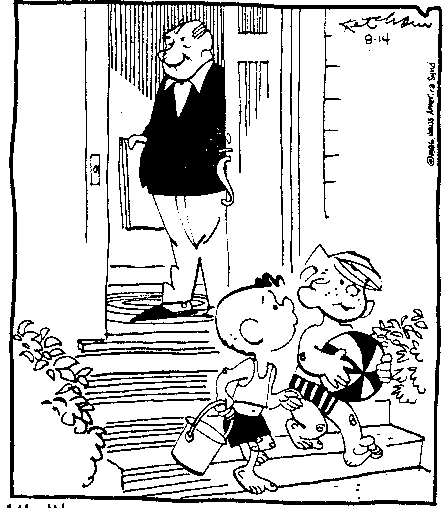
Mr. Wilson said he was happy to see me, but the ‘happy’ never made it to his face.

Presented at the “Under 59 Strategic Planning Weekend”
Saturday, December 12, 2009, 3:30 p.m.
Session IV: Witness & Collaborative Opportunities

It should come as no surprise that a cartoon character that I have followed since childhood is Dennis the Menace. One scene, in particular, shows Dennis and a friend walking out of his neighbor’s house, the Wilsons, with Mr. Wilson standing at the doorway. Dennis says to his friend, “Mr. Wilson said he was happy to see me, but the happy never made it to his face.”

I like this scene because it speaks about the connection between what is said and how it is expressed; in other words, what we do in relation to how we do it. Or, to be more specific in our lives, “the quality of our work and the quality of our presence.”

While it is important to celebrate and affirm the achievements in our professional ministries, we need to consider that how we live our lives may have more of an impact on others than what we actually accomplish in our work.

In thinking about what it means to be faithful and attractive witnesses to Jesus Christ and his Gospel, the term “witness” first comes to mind.

By definition, a witness is one who has seen, heard, experienced and, therefore, believes in something. As Marianists, we are called to be witnesses to our faith.

Some of the basic tenets of our faith include the “Good News”—that we are a people of the resurrection; that darkness always yields to light; that death leads to resurrection; that we are all loved by God; and that the crucifix, which is a symbol of execution, also is a powerful symbol of hope—that death does not have the final word.

With such “good news,” how can we not live our lives with joy, gratitude, passion and enthusiasm?

Being a witness to our faith also keeps us grounded in our realities: the limitations of our resources, the weaknesses of our humanity and the challenges of our daily lives.

Despite these realities, as faithful witnesses, we can hold our ideals before us as a guide to move forward together as a community and invite others to walk with us in hope, joy, passion and enthusiasm for our shared vocation.

And, when others see that joy expressed by how we live our lives, they will find us as faithful and attractive witnesses to Jesus Christ and his Gospel.

Reflection: First Tuesday of Advent

December 1, 2009

Mass: Tuesday, December 1, 2009
First Reading: Is 11:1-10
Responsorial Psalm: 72:1-2, 7-8, 12-13, 17
Gospel: Lk 10:21-24

Advent has always been one of my favorite seasons of the liturgical year. Not only it is a Marian time, it also coincides with the conclusion of the academic semester—and the end of the daily grind of classes. Plus, its selection of readings are comforting, optimistic and full of hope—and today’s readings are no exception.

Isaiah paints a vivid picture of hope for a world where, “on that day,” the wolf and the lamb, the lion and the calf, and the cobra and the child will welcome one another in peace. Imagine: a world without enemies, hatred and division!

The psalm response speaks of “justice and fullness of peace forever.” Such a message of inspiration for us during the hustle and bustle of the final weeks of the semester, advent planning and early Christmas socials.

The Gospel reminds us of those select, but privileged, few who have been revealed the true meaning of God’s love for us. On the heels of our community retreat “In the Steps of Chaminade,” we witness the Gospel in action through the life of our founder who received from Mary the vision of establishing the Marianist family as a gift to the Church and world that is passed on to us.

As Marianist religious, we are asked not only to read the signs of the times—as revealed to us through our interpretations of scripture—but to respond to those needs in action.

When Isaiah speaks of the wolf and the lamb, the lion and the calf, and the cobra and the child welcoming one another, this perhaps can relate to our unique gift of “mixed composition” and how we can share that with our world.

When the psalmist writes, “justice and fullness of peace forever,” this perhaps can relate to how we strive to live community—where every member is cared for and valued equally.

When the Gospel speaks about those who have received the good news, perhaps that has something to do with the way we live faithfully our lives with joy and happiness—characteristics necessary for perseverance, fidelity and stability in our Marianist vocation.

When responding to those gifts we’ve received, sometimes it’s the little things we do for one another that have the biggest impact.

In recent semesters, a few responses to my course evaluations have caught my attention. When asked to identify what the strengths of the course were, some students responded with “the instructor is very happy” and “enthusiastic and excited to each class everyday.”

Despite the wonderful class presentations, thought-provoking discussions, quick turn-around of graded assignments, efficiency in meeting course objectives and ability to take student work from one level to the next—and the reality that, on some days, I rather would have been somewhere else—it was the presence in ministry that made the lasting impression!

Perhaps this has something to do with the idea that “the quality of our work is not as important as the quality of our presence.”

As we approach the altar and begin a new day, one way we might be able to respond, as suggested by the action proposal for the day listed in “Advent 2009: Praying with the Prophets for Peace and Justice,” is to “give extra time to that student in your class who is slow in learning, that member in your community who is confused and seems lost.”

After all, when we have been revealed the “good news,” how can we not help but be joyful and want to share that joy with others?