Archive for the ‘Reflections’ category

Reflection – Saturday Jan. 9

January 9, 2010

“He must increase; I must decrease.”

Today’s Gospel reading presents us with an all-too familiar scene both in the scriptures and in our everyday life.  It is that of a group of disgruntled people.  It is people who are not getting their own way, those who have found something to complain about  (yes, I often fall into this category as well.)  The followers of John come to him and say “The one you baptized is now baptizing others.  And, what’s more, he’s getting a bigger crowd.  The guy on the other side of the river is stealing your show.  He’s taking away all your business!  We were the big show in town and this new guy has come and stolen the limelight away.  What are you going to do about this?”

What is John’s response?  “No problem.  That’s okay.  That’s what I wanted to happen.  In fact, it makes me happy that he’s getting all the hype, that he’s the big show in town now.  That’s been the plan all along whether you like it or not.  I must shrink into the shadows so that that he can enter into the spotlight.  I must decrease and he must increase.”

For us as Marianists, we are called to always point to Christ.  In all that we say and do, we are called, like Mary, to bring Jesus in to the world.  Today’s gospel reminds us through the story of John the Baptist that we must always make sure that it’s about Christ and not us.  It is a reminder of the humility and sense of service that we are called to each and every day.  Through the living of our lives, we are bringing others to gather around that guy on the other side of the river (Jesus) and not ourselves or our individual ministries or whatever else we might be doing at the moment.

As our egos start to deflate, it’s probably a good time to recall that while John the Baptist reminds us of this today, the last several weeks have been one long reminder of this.  The Christmas season has been a continuous story of the manifestation of the Messiah, the one who must increase.  As we come to the end of another Christmas season, we are reminded of the many stories and people who allowed themselves to take a back-seat so that Christ could shine in the world.

The shepherds rejoice not in being visited by angels, but in seeing the newborn king.  The Magi altered their return home and forego a possible “in with the king” to protect the new child.

We have journeyed with Joseph who humbly accepted the will of God in his life.  He could have easily said, “Whoa look what happened to me and my marriage plans.”  But rather he said, “Yes I will forego my own plans and raise Jesus even if it means going to Egypt for a while.”

And, of course, there is the image of Mary, the one who says, “I come to do your will, not mine.”  I am always struck by the numerous icons and statues of the Madonna and Child that depict this so well:  It is Mary holding Jesus for all to see;  It is Mary presenting Jesus allowing him to be in the forefront.

The words of John the Baptist, “I must decrease and he must increase,” are a good summary for the close of another Christmas season.  It is a reminder that we are called to always bring others to Jesus, to help others gather around him who is the light. In all that we do, we must joyfully decrease so that Christ may increase.
Reflection: Third Monday of Advent

December 14, 2009

Mass, Monday, December 14, 2009
Reading: Numbers 24:7, 15-17A
Responsorial: Psalm 25: 4-5AB, 6 and 7BC, 8-9
Gospel: Matthew 21:23-27

There are many slang words that seem to have opposite connotations. For example, “bad” (good), “sick” (amazing); “beast” (mastery). Although not necessarily part of slang jargon, the word “authority” also can be classified in a similar manner.

Authority can have opposite connotations: in a positive way—respect, bestowed on one by others by virtue of talent, gifts and leadership; in a negative way—a presence that changes behavior (slow down while driving).

Regardless of which definition comes to mind first, “authority” is something that compels us to action.

So, what were some thoughts that came to mind when answering the question posed this morning: “How does the authority of our vows compel us to act on our faith?”

The first idea to keep in mind is that whenever we act on our faith, it is the Holy Spirit that prompts our actions.

With that idea in mind, it is important to also look at each of the vows in terms of both its letter and spirit. As Chaminade, himself, warned in his letter to the retreat masters of 1839, “The letter kills but the spirit quickens.” In other words, if we only live by the bounds of the letter of the vows, we will miss out on the richness of what the spirit of the vows truly are meant to teach us.

The spirit of the vow of poverty: not just what we can’t have, but learning to share all of our possessions—money, time and talent—with others and that all of God’s creation must be respected and cared for.

The spirit of the vow of chastity: not about all of the hot dates that we’ll miss, but embracing the life-long lesson of giving and receiving unconditional love.

The spirit of the vow of obedience: not being forced to do something we don’t want, but promising to listen and dialog with each other, discerning God’s will as a community of faith, not an individual.

The spirit of the vow of stability: not that there is no way out if it goes bad, but participating wholeheartedly and giving one’s entire life to the mission.

Like Jesus was asked in today’s Gospel, “By what authority do you do these things?”, perhaps we can answer that is it the spirit of the vows that compel us to action. There are many practical ways to act on our faith—and it doesn’t always have to be something big; the little things also can have significant impact on others.

Here is a practical list, used at the end of the day, to examine our interaction with others. Keep in mind that this list isn’t meant to be checked off and forgotten, but to as a way to examine how we can, in many practical ways, use the authority of our vows to act on our faith:

At the end of your day, ask yourself, “Today, have I…”

  • Greeted someone by his/her first name?
  • Smiled at someone?
  • Hugged someone?
  • Complimented someone?
  • Affirmed someone?
  • Thanked someone?
  • Laughed with someone?
  • Offered a potentially-helpful suggestion to someone?
  • Listened attentively and patiently to someone?
  • Offered to help someone?
  • Actually helped someon?
  • Given someone some of my valuable time?
  • Shown patience with someone who frustrates me or whom I dislike?
  • Tried to cheer-up someone?
  • Prayed for someone?
  • (adapted from a list developed by Brother Jerome Matz, S.M., Ph.D.)

As we gather around the altar, let’s take the time to reflect on these because, after a long day in professional ministry building up God’s reign, we are reminded that when we come home, we are called to continue our ministry by building community with one another as brothers who share a common vocation as Marianists.

Faithful and attractive witnesses to Jesus

December 14, 2009

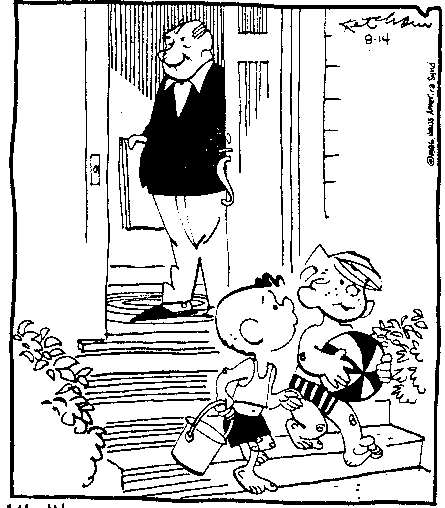
Mr. Wilson said he was happy to see me, but the ‘happy’ never made it to his face.

Presented at the “Under 59 Strategic Planning Weekend”
Saturday, December 12, 2009, 3:30 p.m.
Session IV: Witness & Collaborative Opportunities

It should come as no surprise that a cartoon character that I have followed since childhood is Dennis the Menace. One scene, in particular, shows Dennis and a friend walking out of his neighbor’s house, the Wilsons, with Mr. Wilson standing at the doorway. Dennis says to his friend, “Mr. Wilson said he was happy to see me, but the happy never made it to his face.”

I like this scene because it speaks about the connection between what is said and how it is expressed; in other words, what we do in relation to how we do it. Or, to be more specific in our lives, “the quality of our work and the quality of our presence.”

While it is important to celebrate and affirm the achievements in our professional ministries, we need to consider that how we live our lives may have more of an impact on others than what we actually accomplish in our work.

In thinking about what it means to be faithful and attractive witnesses to Jesus Christ and his Gospel, the term “witness” first comes to mind.

By definition, a witness is one who has seen, heard, experienced and, therefore, believes in something. As Marianists, we are called to be witnesses to our faith.

Some of the basic tenets of our faith include the “Good News”—that we are a people of the resurrection; that darkness always yields to light; that death leads to resurrection; that we are all loved by God; and that the crucifix, which is a symbol of execution, also is a powerful symbol of hope—that death does not have the final word.

With such “good news,” how can we not live our lives with joy, gratitude, passion and enthusiasm?

Being a witness to our faith also keeps us grounded in our realities: the limitations of our resources, the weaknesses of our humanity and the challenges of our daily lives.

Despite these realities, as faithful witnesses, we can hold our ideals before us as a guide to move forward together as a community and invite others to walk with us in hope, joy, passion and enthusiasm for our shared vocation.

And, when others see that joy expressed by how we live our lives, they will find us as faithful and attractive witnesses to Jesus Christ and his Gospel.

Reflection: First Tuesday of Advent

December 1, 2009

Mass: Tuesday, December 1, 2009
First Reading: Is 11:1-10
Responsorial Psalm: 72:1-2, 7-8, 12-13, 17
Gospel: Lk 10:21-24

Advent has always been one of my favorite seasons of the liturgical year. Not only it is a Marian time, it also coincides with the conclusion of the academic semester—and the end of the daily grind of classes. Plus, its selection of readings are comforting, optimistic and full of hope—and today’s readings are no exception.

Isaiah paints a vivid picture of hope for a world where, “on that day,” the wolf and the lamb, the lion and the calf, and the cobra and the child will welcome one another in peace. Imagine: a world without enemies, hatred and division!

The psalm response speaks of “justice and fullness of peace forever.” Such a message of inspiration for us during the hustle and bustle of the final weeks of the semester, advent planning and early Christmas socials.

The Gospel reminds us of those select, but privileged, few who have been revealed the true meaning of God’s love for us. On the heels of our community retreat “In the Steps of Chaminade,” we witness the Gospel in action through the life of our founder who received from Mary the vision of establishing the Marianist family as a gift to the Church and world that is passed on to us.

As Marianist religious, we are asked not only to read the signs of the times—as revealed to us through our interpretations of scripture—but to respond to those needs in action.

When Isaiah speaks of the wolf and the lamb, the lion and the calf, and the cobra and the child welcoming one another, this perhaps can relate to our unique gift of “mixed composition” and how we can share that with our world.

When the psalmist writes, “justice and fullness of peace forever,” this perhaps can relate to how we strive to live community—where every member is cared for and valued equally.

When the Gospel speaks about those who have received the good news, perhaps that has something to do with the way we live faithfully our lives with joy and happiness—characteristics necessary for perseverance, fidelity and stability in our Marianist vocation.

When responding to those gifts we’ve received, sometimes it’s the little things we do for one another that have the biggest impact.

In recent semesters, a few responses to my course evaluations have caught my attention. When asked to identify what the strengths of the course were, some students responded with “the instructor is very happy” and “enthusiastic and excited to each class everyday.”

Despite the wonderful class presentations, thought-provoking discussions, quick turn-around of graded assignments, efficiency in meeting course objectives and ability to take student work from one level to the next—and the reality that, on some days, I rather would have been somewhere else—it was the presence in ministry that made the lasting impression!

Perhaps this has something to do with the idea that “the quality of our work is not as important as the quality of our presence.”

As we approach the altar and begin a new day, one way we might be able to respond, as suggested by the action proposal for the day listed in “Advent 2009: Praying with the Prophets for Peace and Justice,” is to “give extra time to that student in your class who is slow in learning, that member in your community who is confused and seems lost.”

After all, when we have been revealed the “good news,” how can we not help but be joyful and want to share that joy with others?

Reflection: Tuesday of the 33rd Week

November 17, 2009

Mass: Tuesday, November 17, 2009
First Reading: 2 Mc 6:18-31
Responsorial Psalm: Ps 3:2-3, 4-5, 6-7
Gospel: Lk 19:1-10

In keeping with this week’s theme of how our daily scriptures connect with the movie industry, we are given a simple message based on the lives of two leading actors: Eleazar and Zacchaeus.

In the first reading, we find Eleazar, the 90-year old scribe, given the opportunity to escape the death penalty by eating pork—thus demonstrating loyalty to the king and renouncing his own religion. Instead of escaping the death sentence, Eleazar remained faithful to the practices of his religion and, because of his faith, was tortured and killed.

What compelled Eleazar do to such a thing?

In the Gospel, we find Zacchaeus, the wealthy, chief tax collector of Jericho, climbing a tree to get Jesus’ attention while passing by. When Jesus tells Zacchaeus that he will dine at his house, Zacchaeus announces publicly, “I’ll give half of all my possessions to the poor and repay back anyone who I extorted money from 4x as much!”

What compelled Zacchaeus to do such a thing?

Indeed, Eleazar and Zacchaeus are powerful central figures in their respective ‘movies.’ Both performed extraordinary acts by taking a leap of faith. Inspired by their examples, we, too, can be asked the same question: What compels us to do extraordinary things on a daily basis—such as dedicating our lives to the service of Mary’s mission? What fuels our efforts to do the best we can with limited resources? What encourages us when the challenges of life become burdensome and difficult?

Like Eleazar and Zacchaeus, may what compels us to do extraordinary things on a daily basis be our response—through our words and actions—to the many blessings that God gives us.

Reflection: Tuesday of the 31st Week

November 3, 2009

Mass: Tuesday, November 3, 2009
First Reading: Rom 12:5-16ab
Responsorial Psalm: Ps 131:1bcde, 2, 3
Gospel: Lk 14:15-24

Sam Bowie. Kwame Brown. Ryan Leaf. What do they have in common? And what do they have to do with today’s scriptures?

For those who aren’t familiar with NBA or NFL trivia, here are some clues. Sam Bowie was selected as the No. 2 NBA draft pick in 1984 by the Portland Trailblazers who passed on Michael Jordan, Charles Barkley and John Stockton—three of the top 50 NBA players of all-time. Sam Bowie played in 10 injury-filled years in the NBA but was never selected as an all-star nor won a championship.

Kwame Brown was the No. 1 pick in the 2001 NBA draft, selected ahead of all-stars Pau Gasol (who won a championship with the Lakers this past summer), Tony Parker (who has three NBA rings, an NBA Finals MVP and Eva Longoria) and Gilbert Arenas (who is considered an all-star and franchise player with the Washington Wizards). Kwame Brown today is a backup for the Detroit Pistons.

Ryan Leaf, the Washington State quarterback who led the Cougars to the Rose Bowl for the first time in over 70 years was selected No. 2 in the 1998 NFL draft ahead of Charles Woodson, Randy Moss and a dozen other Pro-Bowlers. His career lasted only four years, marked by injuries, poor performance and  poor relationship with his teammates.

These three are considered as the three of the biggest draft busts in NBA and NFL history. Great talent in college and high school, loads of potential but unfortunate situations hampered their careers.

So what do they have to do with today’s readings?

The scriptures remind us today of our giftedness—blessed by God who freely gives us not only the gift of peace as stated in the responsorial psalm, but also individual gifts and talents to make a positive impact on our world.

The lesson in today’s Gospel reminds us that while God blesses us with numerous gifts, it is up to us to take action. Unlike those who make excuses and refuse to attend the dinner they were invited to, we are called to develop our gifts and make a positive impact on our world with our unique contributions.

This new day gives us another opportunity to do this by sharing a simple and kind gesture to others; offering an affirming remark; working to be the best student we can be in our classes; striving to be the best mentor or teacher in our classrooms; and being a brother to all whom we meet today.

Reflection: Monday of the 29th Week

October 19, 2009

stuff

Mass: Monday, October 19, 2009
First Reading: Rom 4:20-25
Responsorial Psalm: Luke 1:69-70, 71-72, 73-75
Gospel: Lk 12:13-21

Clearly, to “believe in the one who raised Jesus our Lord from the dead” is much more than accepting the news that Central Catholic beat St. Joe’s last weekend. To believe in him is to have total trust in God’s loving care for us; willingness to save us from sin and death and to raise us from the dead. To be a Christian means that our security is in God and the risen Son of God. Today’s gospel is a mixture of a warning against greed and a warning to put one’s trust entirely in God and not accumulate wealth. This may be the most difficult demand of discipleship.

The need to acquire is inherent in human nature.  George Carlin satirized our need for things in his monologue about “stuff”:

I don’t know how you are but I need a place to put my stuff. You know how important that is. That’s the meaning of life. Trying to find a place for my stuff. That’s all, a little place for my stuff. That’s all I want, that’s all you need in life, is a little place for your stuff, ya know? I can see it on your table, everybody’s got a little place for their stuff. This is my stuff, that’s your stuff, that’ll be his stuff over there. That’s all your house is: a place to keep your stuff. If you didn’t have so much stuff, you wouldn’t need a house. You could just walk around all the time.

A house is just a pile of stuff with a cover on it. You can see that when you’re taking off in an airplane. You look down, you see everybody’s got a little pile of stuff. All the little piles of stuff. And when you leave your house, you gotta lock it up. Wouldn’t want somebody to come by and take some of your stuff. They always take the good stuff. They never bother with that junk you’re saving. All they want is the shiny stuff. That’s what your house is, a place to keep your stuff while you go out and get…more stuff!

Sometimes you gotta move, gotta get a bigger house. Why? No room for your stuff anymore. Did you ever notice when you go to somebody else’s house, you never quite feel a hundred percent at home? You know why? No room for your stuff. Somebody else’s stuff is all over the place!

Have you noticed that their stuff is junk and your junk is stuff? God! And you say, “Get that junk offa there and let me put my stuff down!”

Like the rich man in the Gospel, we readily collect “stuff” in order to make ourselves more secure, in order as we often say “to have something to fall back on.” The desire for security seems to be one of the most deep-seated traits in our nature. We want something or someone to hold on to. To trust ourselves completely to the God we do not see and not have something more concrete to fall back on is very tough indeed. The people who do it almost completely are the ones we call saints. We stand in disbelief at the sight of them. Most of us compromise quite a bit. Often it seems only misfortune, disaster and loss can teach us to trust totally in God.