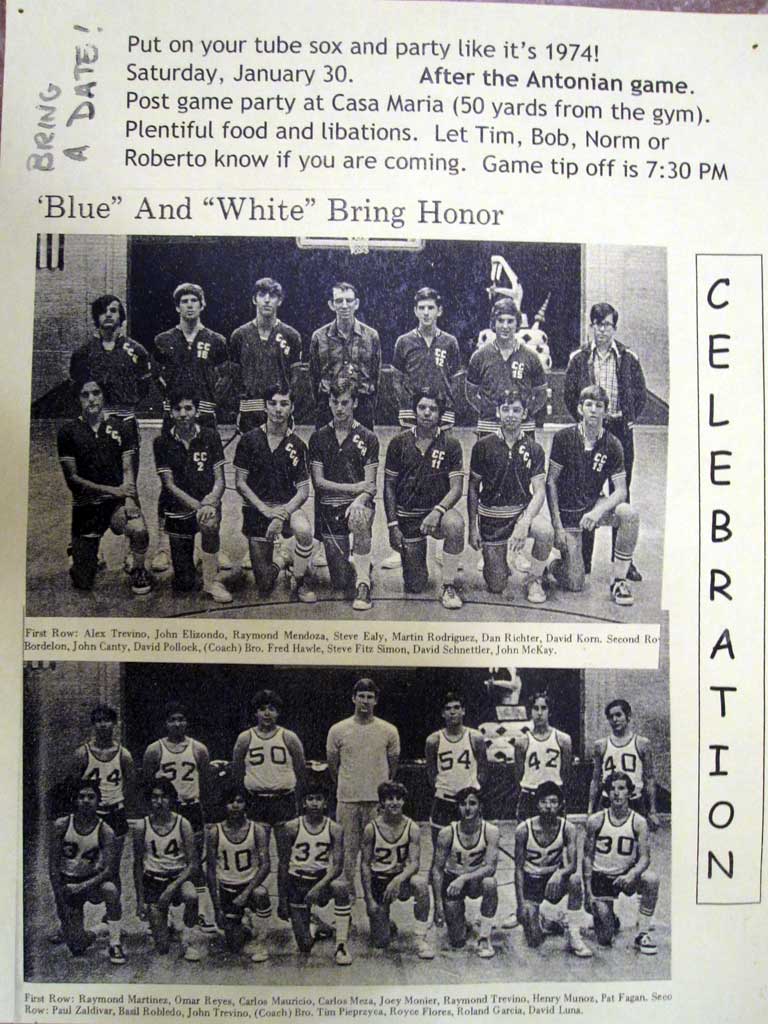
About 30 faculty and staff from Central Catholic high school celebrated a basketball victory over Antonian Prep with a post-game party at Casa María. The game was held a few yards from the community at the Alumni Athletics and Convocation Center on the campus of St. Mary’s University. St. Mary’s alumnus and CCHS faculty member Jose Gonzalez conducted the interviews on video and served as the photographer.
This first verse begins to describe the story of King David who was had an intimate relation with God and from his childhood was a talented musician. Pleasing the Lord could refer both to King Saul and literally the Lord.
David was blessed by God. After the mourning of Saul and winning the civil war, God promised David four things:
That he would have a son to rule after him
That his son would build the temple
That the throne that occupied his lineage would be established forever
And that God would never take His mercy from David’s house.
David truly wanted to follow God and was in turn blessed by God. But, we see in the first reading today that anyone can fall, even someone as blessed as him.
The second verse describes today’s reading of David and Bathsheba.
This story about David can be told in three simple sentences.
Walking on the roof of his house he saw a beautiful woman taking a bath. He sent and inquired about her. And then he took. In those three sentences you have a pretty good description of the processes of temptation. Any temptation in your life and mine could follow this pattern. It starts first with desire stirred in us simply because of human nature. There is nothing wrong with this but the desire is there, and it must be dealt with when it arises.
It can be dealt with properly at that point or it could be formed into something else. David saw the beautiful woman, desired her and then started to work out a way that he could take her. He sent and inquired about her. Then David, the one blessed by God, finds himself committing adultery. This weakened his relationship with God as we hear described in the song as the “broken throne.”
When it was accomplished, he refused to face the music, like so many of us try to do. Instead of openly confessing and acknowledging what he did wrong, and trying to make it right, he committed another sin to cover up. This is always the process of sin. If you commit one sin, you commit another to cover that one up, and then more to cover up the second one. And so on and so on as we later find David eventually responsible for murder. David’s sin with Bathsheba shows us how anyone can fall to temptation.
In a verse from Corinthians we read, “So, if you think you are standing firm, be careful that you don’t fall.” David’s sin with Bathsheba should be a warning to us that we need to be careful to not let our pride take over our spritual maturity and ability to withstand temptation in our own strength.
So, in preparing for today, as is my tendency, I focused completely on the Gospel first. Thoughts of middle school when I started my Catholic education were brought back. At that time we used this parable to describe something like love and goodness, and all the other fluffy stuff.
So, the other day when I shared the Gospel with a co-worker, I was totally confused with her take on it. She brought a different view on it that, at first, given the Gospel alone, made no sense.
She said, “Well, we’re planting seeds all the time. It’s the seeds you plant early in your life that will affect you later. In our younger years, we are trying to find who we are and that’s when we pant a lot of seeds. Sometimes we plant good seeds that turn into something beautiful and sometimes we plant seeds that come back to bite us. We don’t usually realize what we planted until were older.”
In my head, I was like, “What are you talking about?” I thought that she was totally off-base and that what she was saying was great; but, as far as an interpretation to the Gospel, she was really far from it. Now again at the time I hadn’t even looked at the first reading about David and Bathsheba, but later on in the day when I did, her words actually made some sense.
Tying the Gospel to the reading, I wonder what kinds of seeds David planted. Before he became king of Israel and Judah, what were those seeds that grew to eventually lead him to all of his triumphs. Also, what were those seeds that grew to eventually lead him to adultery with Bathsheba, the murder of Uriah, and all of the other troubles we find in the second half of the second book of Samuel.
This could be something we could think about today. What are those tiny seeds that we are planting? Are these seeds, when fully grown, be ones that we will be thankful for or ones that will come back to bite us. What kinds of seeds will we plant today?
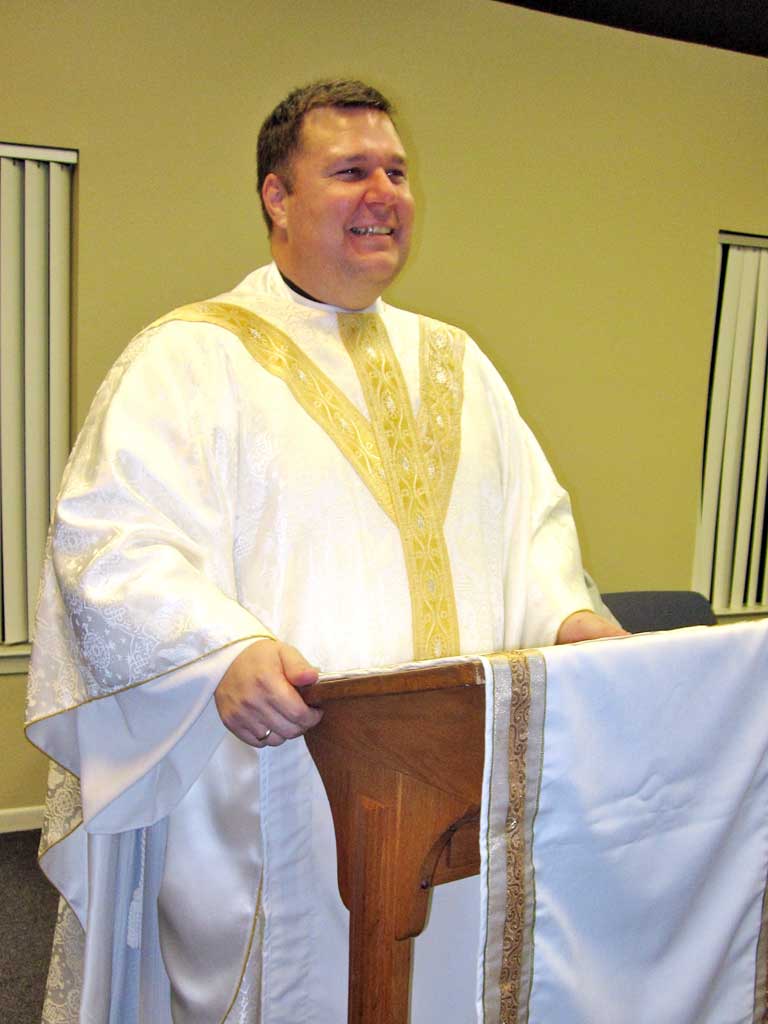
Rev. Pat McDaid (Woodlawn Community) presided at the Thursday evening Mass at Flores Hall with the brothers of Casa María and students of St. Mary’s University, Jan. 28.
In his homily, Pat put the Gospel into perspective for the congregation:
Here in the Sacred Space of St. Mary’s University,
you have received
are currently receiving,
and will continue to receive a lamp…where will you place it?
The brothers were treated to a special dessert for dinner—homemade tres leches made by Diego Hoenigman’s grandmother, Mrs. Gomez. Unfortunately, there were no leftovers as the dessert lasted only one night.
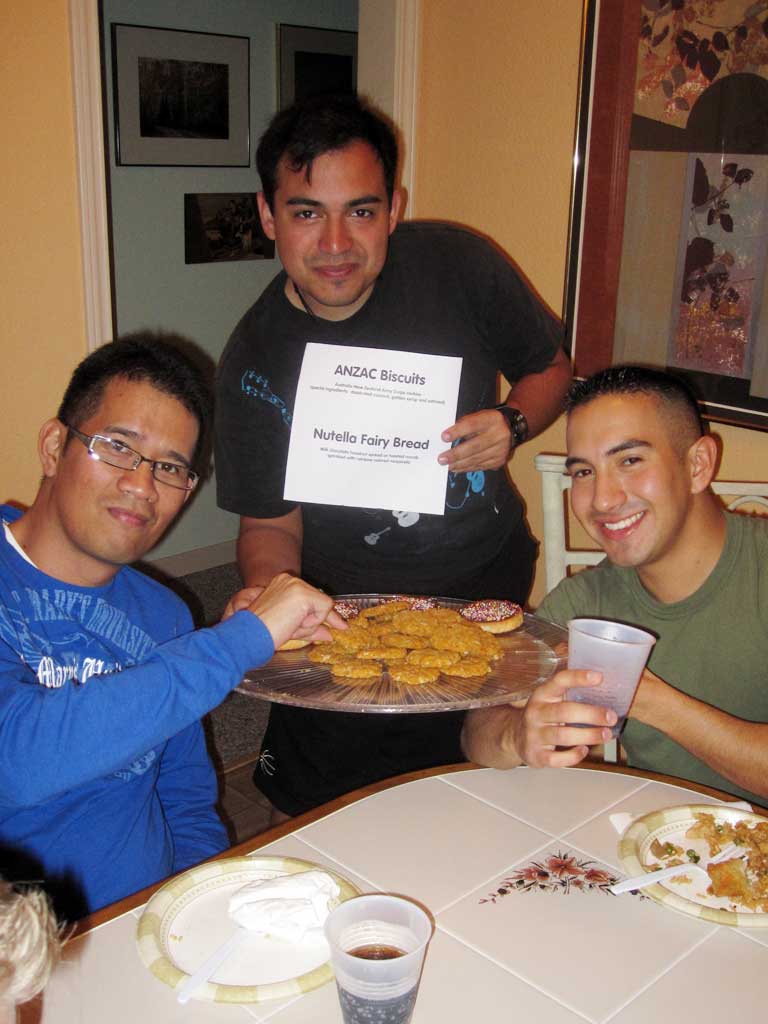
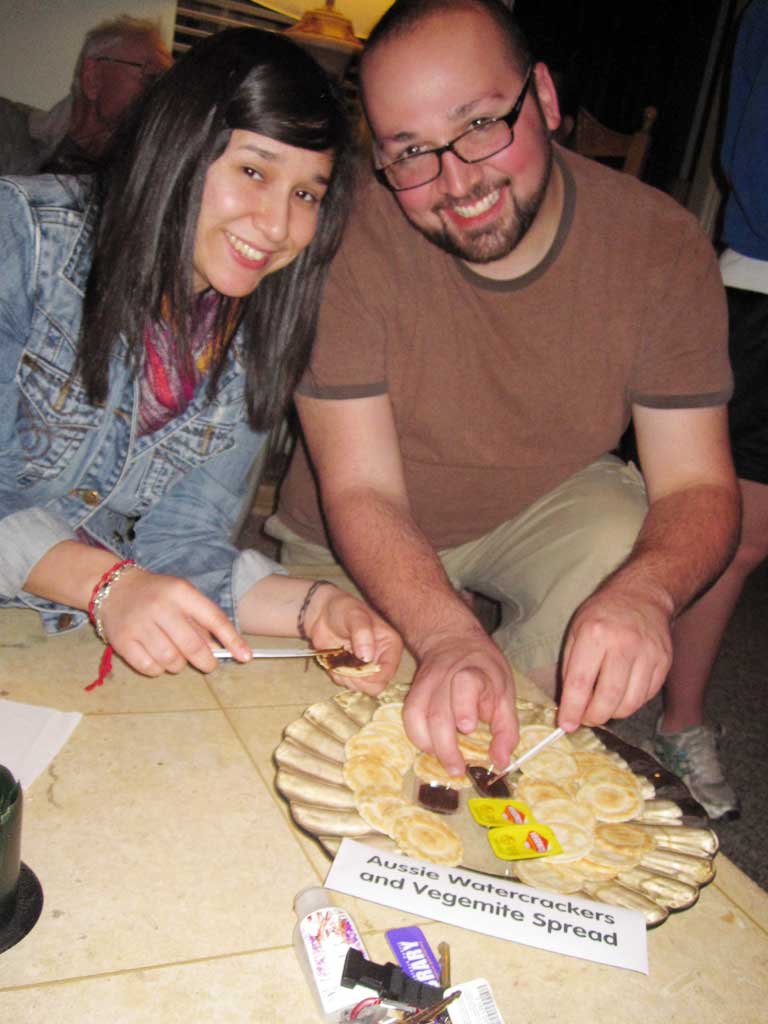
Casa Tuesday celebrated with the theme of Australia Day (January 26) by featuring cuisine from the land of “Down Under.”
Items included on the menu were ANZAC Biscuits (Australia-New Zealand Army Corp cookies with a special ingredient of dessicated coconut, golden syrup and oatmeal) Nutella Fairy Bread (milk chocolate hazelnut spread on toasted rounds sprinkled with rainbow-colored nonpareils) and Aussie Watercrackers with Vegemite Spread.
When celebrating Mass on the day when the lives of saints are commemorated, the Church, in all her wisdom, strives to incorporate the best of all worlds—and today is a perfect example.
Today is the feast of Sts. Timothy and Titus which adds a number of options to choose from when selecting scriptures for Mass. As suggested in Living with Christ, today’s readings are drawn from the 3rd Tuesday in Ordinary Time as well as the Saint’s feast.
As expected when such an event happens, a unique combination of scripture results. For those who prepare daily reflections, this presents an interesting challenge that compels one to discover the hidden wisdom that we can reflect on and apply to our daily lives.
So, here’s one possible perspective…
In the first reading, Paul affirms Timothy’s faith as passed to him by his grandmother, Lois, and mother, Eunice. The other option for today’s first reading—Paul’s letter to Titus—includes the phrase, “Titus, my true child in our common faith.”
In the Gospel, Jesus states that those who do the will of God and are his family—mother, brother and sister.
Perhaps this combination of scripture reveals a theme about who we are and how our actions define that identity.
Not only do we take on the name of Christians, we also are Marianists—specifically, Marianist religious brothers. So what does it mean to be a “brother to all people”? How does this identity compel us to action?
An obvious area where we serve as a brother to all is in our public ministries. It’s easier to see how we serve as brothers in ministry together at our various institutions. We, like many who have done before us in our rich history, excel in our ministries, do great work, are committed to the mission, and are hard-working professionals—wonderful examples of selfless giving to our world.
When we come home, we are spent! But, we are reminded that when we come home, our role as brother doesn’t stop when we leave our ministry. Our gifts of presence, patience and openness to one another is need much more here in our home.
I often wondered why the theme for our province assembly in 2007 was “Becoming Brothers.” For a religious congregation who professes that community life, discipleship of equals and mixed composition are sacred values, becoming “brothers” to one another is expected to be a reality. Or, perhaps it is because that becoming “brothers” to one another in community can be one of the most difficult challenges of religious life that requires a lifetime of faithfulness in seeking that goal.
We are blessed with numerous gifts, talents and personalities. Our diversity is rich. Yet, it is that same diversity that challenges us to be faithful to our identity of being a community of “brothers” to one another in one heart and mind.
Doing the little things for one another is what makes for good community. Trusting that we will be present for one another at prayer, work, play, community and calling each one of us to be more than we think we can become supports one another in being faithful.
Let us pray that we make this new day another opportunity where we can be faithful to our role of being a “brother to all people” and reveal that identity through our actions.
Louie and Bob celebrate founder’s day at the Woodlawn Community
Marianists from the Casa María and Ligustrum communities gathered at the Woodlawn community to celebrate Chaminade Day with vespers, appetizers, dinner, dessert and frequent updates of the NFC championship game on Sunday evening, Jan. 24.
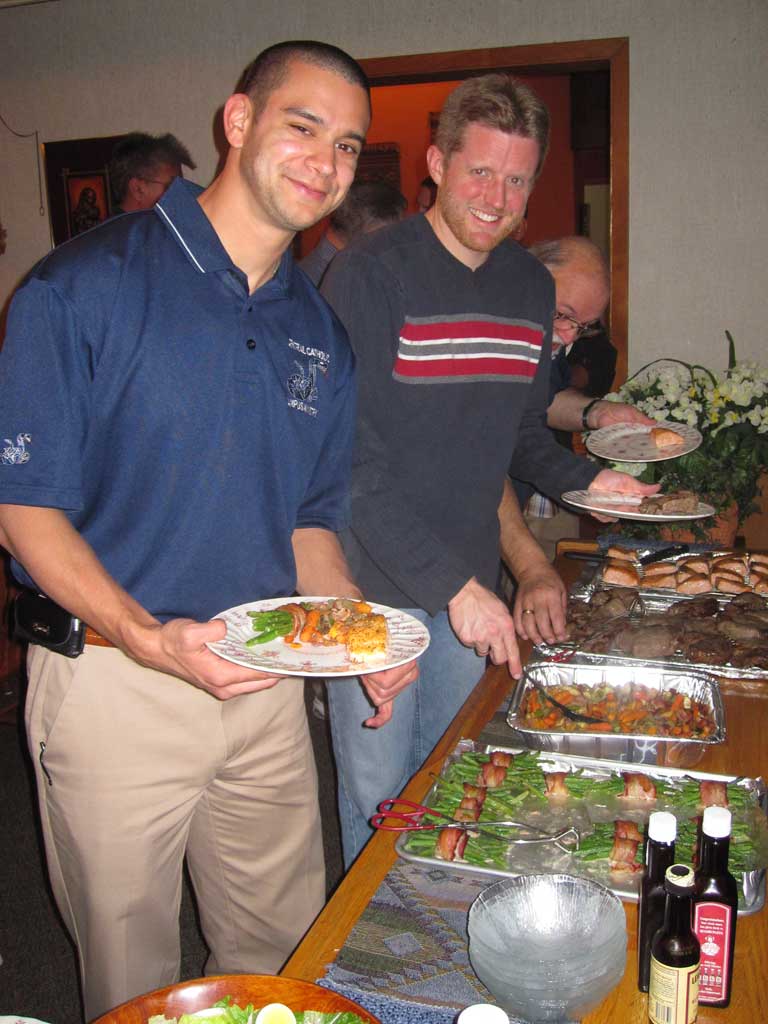
Pictured above are Louie and Brother Bob at the dinner line which featured salmon, steak, potatoes and green beans wrapped in bacon. Bob was in a particularly celebratory mood after finding out that the Indianapolis Colts won the AFC championship.
¡Bienvenidos! Welcome to the official Casa María Marianist Community blog. This work-in-progress serves to document our events and activities—much like traditional community annals, but in electronic form.
We also hope that through the witness of our lives shared with the larger online community, visitors may participate in discovering the gift of the Marianist charism through this blog.



 Casa Maria Marianists