Archive for the ‘Reflections’ category

Reflection: Our Lady of the Pillar

October 12, 2009

2009-10-12-pillar

Mass: Feast of Our Lady of the Pillar
First Reading: 1 Chronicles 15:3-4,15-16;16:1-2
Gospel: Luke 11:27-28

Reflection
About 200 years ago, France was in the middle of a revolutionary war. The focus of the conflict was a struggle of power between politics, government and religion. By virtue of being a Roman Catholic priest, Blessed Chaminade was forced out of France and exiled to Spain. He arrived on the evening of October 11, 1897 in time to witness the vigil celebration of Our Lady of the Pillar in Zaragosa.

Over the next few years, while waiting to return home to France, Blessed Chaminade spent a lot of time in prayer at the basilica of Our Lady of the Pillar; it was there that he received a vision from God through Mary.

Although the exact nature of that vision never was revealed in detail, it resulted in the founding of the Marianist Family—the Lay Marianists, Sisters and Brothers / Priests.

While 200 years and a different country may seem far away from us here today, our world is quite similar to that of revoluationary France in the late 1800s. We don’t need to read too far into the current news headlines to find that our world is in need of healing.

So, what can we do, in our own little ways, to help our world in need of healing? Blessed Chaminade’s mission was clear and it involved two parts: 1) the salvation of souls and 2) to build communities centered in faith.

The idea behind the first part—the salvation of souls—echoes that of today’s first reading where the ark of the covenant, a container of God, is to be revered and considered as sacred. Just as we are created in God’s image, we, too, are reminded that we are loved by God and containers of Christ.

This sacred respect for the soul present in the human body is reflected in the Hawaiian concept of Aloha. Aloha is more than just a greeting or farewell; aloha is also translated as love, affection, mercy, grace. It also is combined from two other words—‘alo’ (face) and ‘hā’ (breath, which contains one’s sacred spirit and soul). So when greeting one another in Hawai‘i, an embrace and exchange of ‘hā’ is the true meaning of aloha—a way of recognizing and respecting the life force, God’s spirit, within whomever we encounter.

The idea behind the second part—community—echoes that of the Gospel. “Blessed are those who hear the word of God and observe it.” As valuable as our faith is to us, it is not meant to be kept to ourselves; it is meant to be shared; this means to give the gift of our talents, our selves and our charism to one another as our response to God’s love for us.

In our zeal to share this charism, I think the biggest temptation we need to be aware of is that of doubt, disappointment and discouragement. When we doubt our abilities, when we think we aren’t good enough or talented enough, when we are discouraged because we don’t perceive results from our efforts—that’s the greatest sin because it goes against our mission of “glorifying God in all places through the Immaculate Virgin Mary.”

It has been said that the Marianist charism seems to be the Church’s “best kept secret.” In some ways, I can understand the thought behind that statement, although I find myself thinking that our way of life is too good to be kept a secret. Just in this chapel alone, I believe we have more than enough talent, creativity and energy to share this with others and not keep it the “Church’s best kept secret.” And that’s why, as different as we are, we come together in community to share in our common mission as Marianists.

So, as we prepare to receive the eucharist, let us pray in gratitude for our Marianist vocation, the vision that Blessed Chaminade passed on to us, and for the strength to be faithful to our mission of “glorifying God in all places through the Immaculate Virgin Mary. Amen.”
Marianist World Day of Prayer, October 11, 2009

October 11, 2009
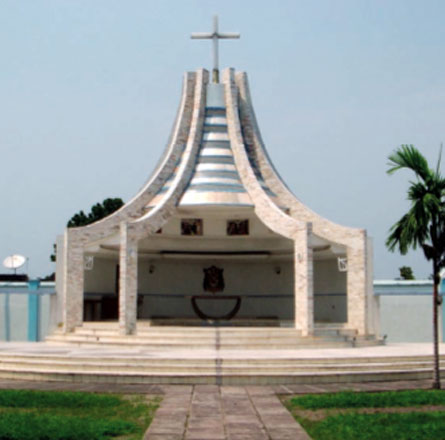
Shrine of Our Lady of Peace of Fatima Kinshasa, Democratic Republic of the Congo

Shrine of Our Lady of Peace of Fatima Kinshasa, Democratic Republic of the Congo

Prayer for the Marianist Family by Jose María Arnaiz, S.M.

“Our Father, we pray for our Marianist Family
with all its weaknesses and all its wealth.
Look upon us with kindness;
it is our mother and our family.

Give it your grace so that it may become
what it longs to be.
“A family that fosters life and enthusiasm,
in which all can express what they think and feel,
what they believe and desire;
a community of freedom.

“A family in which all can pray in their own language,
develop and cherish their own culture,
appreciate the heritage and history in which they feel
at home:
an incarnational community, one that knows the
paschal mystery
and experience a new Pentecost.

“A family of which people will say:
“See how they love one another,’
rather than, “See how well organized they are’:
a living and growing community.”
Marianist Family, you are small but growing,
Fragile but full of hope,
Hesitant but believing.
Lift up your eyes and see:
Jesus and Mary are always with you. Amen.”

Prayer for the Marianist Family by Jose María Arnaiz, S.M.
“Our Father, we pray for our Marianist Family
with all its weaknesses and all its wealth.
Look upon us with kindness;
it is our mother and our family.
Give it your grace so that it may become
what it longs to be.
“A family that fosters life and enthusiasm,
in which all can express what they think and feel,
what they believe and desire;
a community of freedom.
“A family in which all can pray in their own language,
develop and cherish their own culture,
appreciate the heritage and history in which they feel
at home:
an incarnational community, one that knows the
paschal mystery
and experience a new Pentecost.
“A family of which people will say:
“See how they love one another,’
rather than, “See how well organized they are’:
a living and growing community.”
Marianist Family, you are small but growing,
Fragile but full of hope,
Hesitant but believing.
Lift up your eyes and see:
Jesus and Mary are always with you. Amen.”

More info on the Marianist World Day of Prayer 2009 (pdf).

Reflection: Our Lady of the Rosary

October 7, 2009

2009-10-07-casa-rosary-reflection

Memorial, October 7

Mass
First Reading: Jon 4:1-11
Responsorial: Ps 86:3-4, 5-6, 9-10
Gospel: Lk 11:1-4

Reflection
I had a hard time choosing between the readings of the day and the memorial of Our Lady of the Rosary. On one hand, following the saga of Jonah always makes for an interesting read and, on the other, listening to Mary’s vocation unfold in scripture is one that is always special to us as Marianists.

At the start of Mass, I went with the readings of the day because that guarantees I get to talk about Jonah as well as Mary!

As outside observers listening to his story, we discover that Jonah has an interesting story. He is quite a character who is called by God and tries to do what God asks of him. However, along the way,  he seems to get distracted and lose focus.

Instead of going to Nineveh, he runs away. He survives an incredible, three day ordeal of being swallowed by a fish. He finally does what God asks in Nineveh and, because of his efforts, the people repent! Yet, Jonah is displeased, becomes angry and wishes for death!

Jonah is such a human character and, in many ways, I can see myself in his actions. In my zeal to do God’s work, the reality of our inevitable humanity and shortcoming makes me question God’s presence. I sometimes lose focus of God’s love around me amid the challenges of daily life.

So, how do we focus on God’s love in the presence of our world’s imperfections? Today’s readings and memorial offer us an answer: Prayer.

There are many methods of prayer: The Rosary, the Our Father (which is the Gospel of the day), music, spiritual reading, meditation, faith-sharing, chanting psalms, etc. Despite these many ways to pray, Blessed Chaminade reminds us that there are few people of prayer.

One way to become people of prayer is to take to heart the following quotes:

“forgive our sins as we forgive others.” As C.S. Lewis once said, “we all believe that forgiveness is a beautiful concept, until we have to practice it.”

“Lord, treat me tomorrow as I treat others today.” — Whoah, that really holds us accountable to our actions!

“I am the servant of the Lord. Let it be done to me according to your word.” From the Gospel of today’s memorial, we hear the example of Mary who, despite the fact that she did not know the entirety of her vocation and where that would lead, said, “Yes.”

Mary faced several challenges in her vocation and, like Jonah, may have wanted to run away. But because of her faith, she remained focused on God’s promise and serves as an example for us to follow.

As we continue our celebration of the memorial of Our Lady of the Rosary, let us call on Mary to intercede for us as we grow to become her other Christs—Sons of Mary for the salvation of souls.

I had a hard time choosing between the readings of the day and the memorial of Our Lady of the Rosary. On one hand, following the saga of Jonah always makes for an interesting read and, on the other, listening to Mary’s vocation unfold in scripture is one that is always special to us as Marianists.
At the start of Mass, I went with the readings of the day because that guarantees I get to talk about Jonah as well as Mary!
As outside observers listening to his story, we discover that Jonah has an interesting story. He is quite a character who is called by God and tries to do what God asks of him. However, along the way,  he seems to get distracted and lose focus.
Instead of going to Nineveh, he runs away. He survives an incredible, three day ordeal of being swallowed by a fish. He finally does what God asks in Nineveh and, because of his efforts, the people repent! Yet, Jonah is displeased, becomes angry and wishes for death!
Jonah is such a human character and, in many ways, I can see myself in his actions. In my zeal to do God’s work, the reality of our inevitable humanity and shortcoming makes me question God’s presence. I sometimes lose focus of God’s love around me amid the challenges of daily life.
So, how do we focus on God’s love in the presence of our world’s imperfections? Today’s readings and memorial offer us an answer: Prayer.
There are many methods of prayer: The Rosary, the Our Father (which is the Gospel of the day), music, spiritual reading, meditation, faith-sharing, chanting psalms, etc. Despite these many ways to pray, Blessed Chaminade reminds us that there are few people of prayer.
One way to become people of prayer is to take to heart the following quotes:
“forgive our sins as we forgive others.” As C.S. Lewis once said, “we all believe that forgiveness is a beautiful concept, until we have to practice it.”
“Lord, treat me tomorrow as I treat others today.” — Whoah, that really holds us accountable to our actions!
“I am the servant of the Lord. Let it be done to me according to your word.” From the Gospel of today’s memorial, we hear the example of Mary who, despite the fact that she did not know the entirety of her vocation and where that would lead, said, “Yes.”
Mary faced several challenges in her vocation and, like Jonah, may have wanted to run away. But because of her faith, she remained focused on God’s promise and serves as an example for us to follow.
As we continue our celebration of the memorial of Our Lady of the Rosary, let us call on Mary to intercede for us as we grow to become her other Christs—Sons of Mary for the salvation of souls.a

Reflection: “Who do you say that I am?”

September 26, 2009

September 25
Friday of the 25th Week in Ordinary Time

Gospel: Luke 9: 18 – 22

This question posed by Jesus in today’s Gospel is one that has been asked throughout history.  It was a question for the people of Jesus’ time as they tried to figure out who Jesus was in terms of a Messiah.  It was a question even for those closest to Jesus and one that Peter answered.  And, it continues to be a question that each of us must answer for ourselves today.

I find it helpful to remember that each of us is created in the image and likeness of God, and we are the sisters and brothers of Jesus.  When we are confronted with the question, “Who do you say that I am?” are we able to look at others and see the face of Jesus?  Can we see Jesus in our midst and recognize him in:

  • The person walking the other direction?
  • Our co-workers?
  • The students and others we minister to?
  • The homeless individual asking for spare change?
  • The foreigner or other who doesn’t look or speak like us?
  • Our community members?
  • Ourselves?

The list could go on and on as we think about the many opportunities we have each day to encounter Jesus and truly discover how he comes to us in our lives.  Let us ponder today who this Jesus is for us and how we can answer the question, “Who do you say that I am?”

Reflection: Marianist Martyrs of Ciudad Real

September 18, 2009

2009-09-18-casa-martyrs

Mass
First Reading: Wisdom 3:1-9
Gospel: John 12:24-26

I wrote this reflection for mass this morning, and I hope you all find it thought provoking as you pray today.

The first reading tells us that if a just person dies for God, their spirit lives on and God will accomplish great things through them.

In the Gospel, Jesus speaks of the wheat, and how it must die to produce fruit. I think especially of the fruit produced in Jesus’ own death.

The prevailing message of our readings today seems to be this:
“if you want to follow Christ, if you want God to accomplish greatness through you, you must die to the life you had before. You must give up the possessions and concerns of this world and be reborn in Christ.”

Certainly, martyrdom is the ultimate example of this kind of death, but I also think about our own journeys as Marianists. The sacrifices we make, the things we have to give up in order to live this Christ filled life that we strive for.

I don’t think the readings are telling us “strive for martyrdom.”
I think they are saying “be willing to let go of those things you think are important so that God can show you true life in Himself”

As I think of our martyrs today, I realize that I cannot ever know what was going through their minds in those moments so long ago. But I wonder, did they have peace? Peace in knowing that through their lives as Marianists, they had already died to this world and began to live in Christ. Could they have had joy in this kind of death knowing that now they were going to live WITH Christ?

Like I said, I don’t know, and I can only pray about what I would do if placed in their circumstances, but I think the lives of Carlos, Fidel and Jesus, as well as today’s, readings remind us that we are all called to sacrifice for God and of the ultimate benefits of those sacrifices (eternal life with God). I think that today, our challenge is to live by their example, to be willing to follow God unconditionally, perhaps even to martyrdom.

I often wonder, can I do that?

~Andrew Caruso, Marianist Aspirant

Reflection: Our Lady of Sorrows

September 15, 2009

Memorial, September 15

Mass
First Reading: 1 Tm 3:1-13
Responsorial: Ps 101:1b-2ab, 2cd-3ab, 5, 6
Gospel: Lk 2:33-35

Reflection
It seems highly appropriate after celebrating the Exaltation of the Holy Cross, the Church follows that with a Marian Feast, Our Lady of Sorrows, as it reflects Mary’s close presence in the life of her son, Jesus.

This memorial, formerly known as the “Seven Sorrows of Mary”, includes many options for scripture: the first reading from the memorial or of the day; the “Stabat Mater” sequence; and the Gospel from either the scene at Calvary or Simeon’s prophecy.

Like the symbol of the Cross, Mary’s entire life was a sign of contradiction: becoming pregnant out of wedlock; becoming mother and daughter to God; becoming homeless at the time of her child’s birth; becoming a refugee to flee her own country; becoming a parent who outlives her child; becoming mother to all when her son dies; becoming a model of faith to witness that the resurrection—and not death—has the final word.

In many ways, our lives as Marianist religious are signs of contradiction: through our vow of poverty, we become rich in sharing the greatest treasure in our lives: God; through our vow of chastity, we learn the lifelong lesson of giving and receiving unconditional love; through our vow of obedience, we learn the importance of listening and mutual discernment of God’s call; and through our lives in community, we discover the person God wants us to become.

A personalized addendum to Timothy’s letter could speak about the role of a professed Marianist religious: Marianists, too, will become a sign of contradiction to the world; bound by their evangelical vows of poverty, chastity, obedience and stability, they are faithful to Mary’s mission of leading others to Christ.

As we begin our day and prepare to receive the Eucharist, let us pray for the strength to become faithful signs of contradiction in our world and share the joy of our Marianist charism with all whom we meet today.

Reflection: Exaltation of the Holy Cross

September 14, 2009

2009-09-15-reflection-timmer

September 14, 2009

Mass
First Reading: Nm 21:4b-9
Responsorial Psalm: Ps 78:1bc-2, 34-35, 36-37, 38
Second Reading: Phil 2:6-11
Gospel: Jn 3:13-17

Chances are that if someone mentions McDonald’s, you visualize the golden arches. Chances are also that you would recognize those golden arches even if they were in black and white, or green against red. The McDonald’s logo is so recognizable that it is iconic. That’s the sort of brand recognition for which you strive in the business world—a symbol that will be immediately recognized as your logo no matter where it appears.

That’s some thing that most business people understand instinctively. That’s why businesses trying to establish a brand identity often begin with a logo, and why companies that want to change their image often start by redesigning their logo to one more in line with the new image they want to present to the world.

The logo gives a first visual impression of the business. Anywhere it appears, the logo must be clear, sharp, distinct and unmistakable.

Branding identity and a strong company logo are essential pieces of the marketing puzzle, but finding and using the right company logo are often misunderstood and even implemented poorly or incorrectly.

Many successful companies have used a single company logo without any change for many years simply because the one they have chosen reflects who they are and what they do. There are advantages to using one company logo. Using one design consistently assists in the communication of your company message directly to current and potential clients. Company logos can help a business cement its brand in the market place by differentiating your products from others that are similar.

When it comes to a company logo, having a single focus is critical. You must be clear on what your identity is first, develop a concise company logo that clearly states your company’s identity, and then repeat the use of this design strategically to reinforce the message. Once you have your company logo developed, it is tempting to branch out and extend it so that it looks different for different purposes. You need to be careful not to dilute your logo should you do this. In order to retain the strength of the design and build company logo loyalty, you must keep your company logo focused and unchanged.

Logo symbolizes your company and provides an image nothing else can provide. It is one of the many important, yet missed, elements for many businesses. Either the company doesn’t have one or it isn’t good enough. It is crucial to have a logo for branding purposes and it gives your company an identity. A company without a logo will raise questions about your business and will result in a loss of identity. The shape has either to correlate with the name or be relevant to your business. It is best not to have the logo be something that the client has to guess to bring out the traits of your business. The logo is a must to build brand image because it conveys the qualities and thoughts of the business to the people.

There are also those who believe that logos do not really have much meaning behind them. They weren’t necessary in building the brand. Logos are important after you establish the brand. The importance of logos is overblown, especially if a business is not committed to branding. Branding is about positioning. It’s about living a promise and creating a relationship with your client. It’s not about graphic design. A logo is not branding.

From Numbers we hear the tale of a bronze serpent raised up (exalted), obviously pre-figuring the crucifixion of Jesus. The psalm sings of human sin and God’s mercy. The epistle to the Philippians emphasizes the enormous irony that the word of God took on “the form of a slave” and was “obedient to death, even death on a cross.” The most painful and humiliating form of torture and punishment becomes the instrument of our salvation and, for us, the sign of both our faith and God’s love. Finally, the Gospel from John puts these images together: Moses and the serpent, the Son of Man coming from and returning to the Father, God’s love and our salvation.

As we pray at the offertory, may this sacrifice once offered on the cross to take away the sins of the world now free us from our sins.

– Brother Tim