Reflection: 5th Tuesday in Ordinary Time

Posted February 9, 2010 by Hoahanau Malianika
Categories: Reflections

Mass: Tuesday, February 9, 2010
First Reading: 1 Kgs 8:22-23, 27-30
Responsorial: Psalm 84:3, 4, 5 and 10, 11
Gospel: Mk 7:1-13

One way that I was taught to pray with scripture was to imagine myself in the story and find a character or group with whom I could identify.

In today’s two readings, there are two central characters cast in the roles of good and bad: Solomon, who behaves as the protagonist in the first reading; and the Pharisees and scribes, cast as the antagonists in Mark’s Gospel.

Of course, we easily can see that if the Pharisees and scribes were only open to Jesus’ teachings, all would be well!

While we would like to align ourselves with Solomon, it should not be too much of a stretch to imagine that, at some point in their lives, the Pharisees and scribes were also like Solomon—one of the “good guys.” After all, as leaders of a worship community, they must have earned that honor somehow.

So what happened to them? How did they lose focus in living the true nature of their faith in favor of practicing rote traditions? When did following established customs become more important than an openness to discerning new insights? When did a single interpretation of expressing faith become “baptized” as the one, correct and absolute standard by which others are judged?

How ironic is it that these questions are posed by the one person in community who has been described as “someone whose schedule you can set your clocks by.” I have to admit that I prefer to have my schedule set a specific way to provide structure and perceived sense of efficiency in my life.

After all, having a set way of doing things helps me to settle, feel efficient and become comfortable. It’s efficient and works—why try a different way?

Although this attitude isn’t necessarily a bad thing, this mindset offers little room for flexibility, openness to variety and new ideas. My years in formation and spiritual direction have taught me to try and temper my strict adherence to established ways with a disposition of openness; in other words, while diligence and efficiency are great, don’t be closed to discerning the variety of other ways that God can be active in life…and I’ll honestly admit, that is the one area that I’ve struggled with and will have to continue working on over the years.

So, when Jesus points out the hypocrisy of the Pharisees and scribes, I easily can imagine that Jesus reminds me that, sometimes, my own personal actions do not match with the words that I speak.

Fortunately, the “basics” our lives as Marianist religious offer us many ways to grow in that area: centeredness in prayer; listening to God’s response as spoken through the voices of others, particularly our brothers in community; understanding how God is working through our strengths and weaknesses; and how our shared life calls us to be accountable to one another in being faithful to our vocation.

Brothers, we are given the gift of another new day and opportunity to live those values and put them into action as concrete expressions of our faith. Let us strive to make the words we speak in chapel match up with our lived actions so that we continue to grow personally and spiritually, and as community.

May the eucharist that we receive this morning renew our commitment to the vocation that we are called to live as Marianists.
CCHS Marianists host Super Bowl party

Posted February 7, 2010 by casamariasm
Categories: Community News

Tags: , , , ,

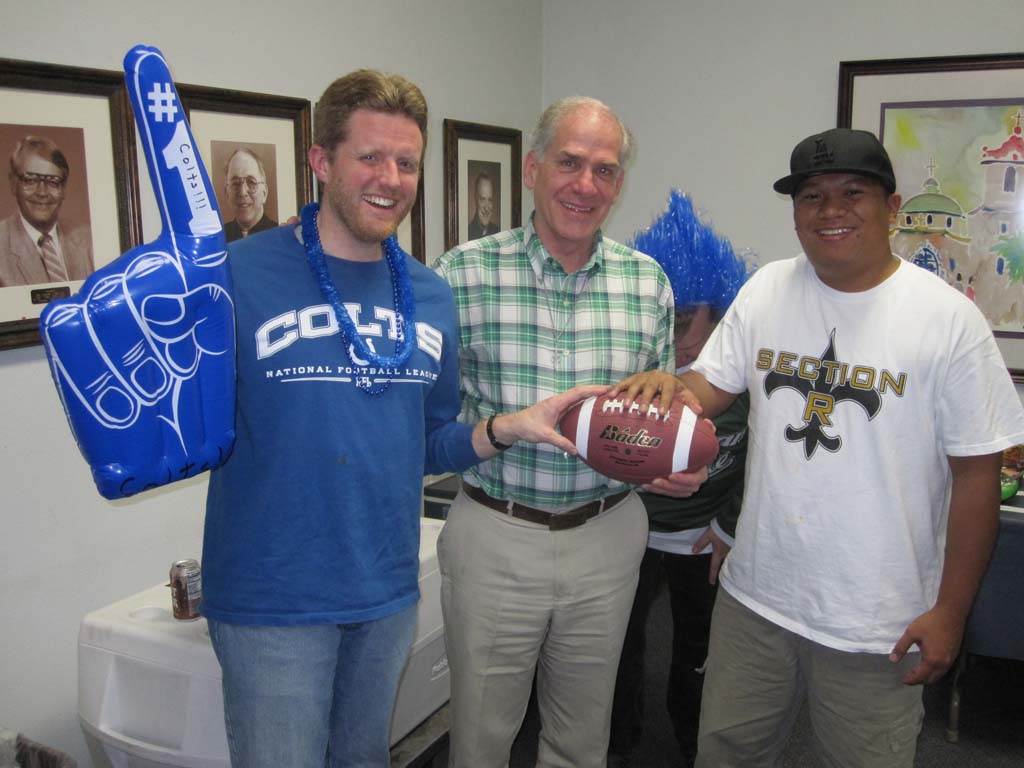
Provincial-designate Marty (center), stands between Colts-Fan Bob and Saints-Fan Norman

About 40 Marianists from the San Antonio area gathered for the annual Super Bowl party at the Central Catholic High School Marianist Community on Sun., Feb. 7.

Warm chili, drinks, fresh fruits and vegetables were served while a large rendition of game was projected on the wall in the school’s conference room.

While a majority of the crowd left at halftime, most of the brothers of Casa María stayed well into the second half to witness the Saints win over the Colts 31-17.

More photos on our Flickr set.

“Who Dat?” video features CCHS Marianists

Posted February 3, 2010 by casamariasm
Categories: Community News

Tags: , , , , , ,

Central Catholic High School salutes the New Orleans Saints and Tom Benson on their journey to the 2010 Super Bowl. This video features all Marianists on staff at the school, including several brothers of Casa María.

Tom, owner of the New Orleans Saints and a San Antonio businessman, is a longtime Central Catholic supporter. Last September, thanks to a $4 million gift by Tom and Gayle Benson and Family, the school renamed its stadium to honor the memory of his son.

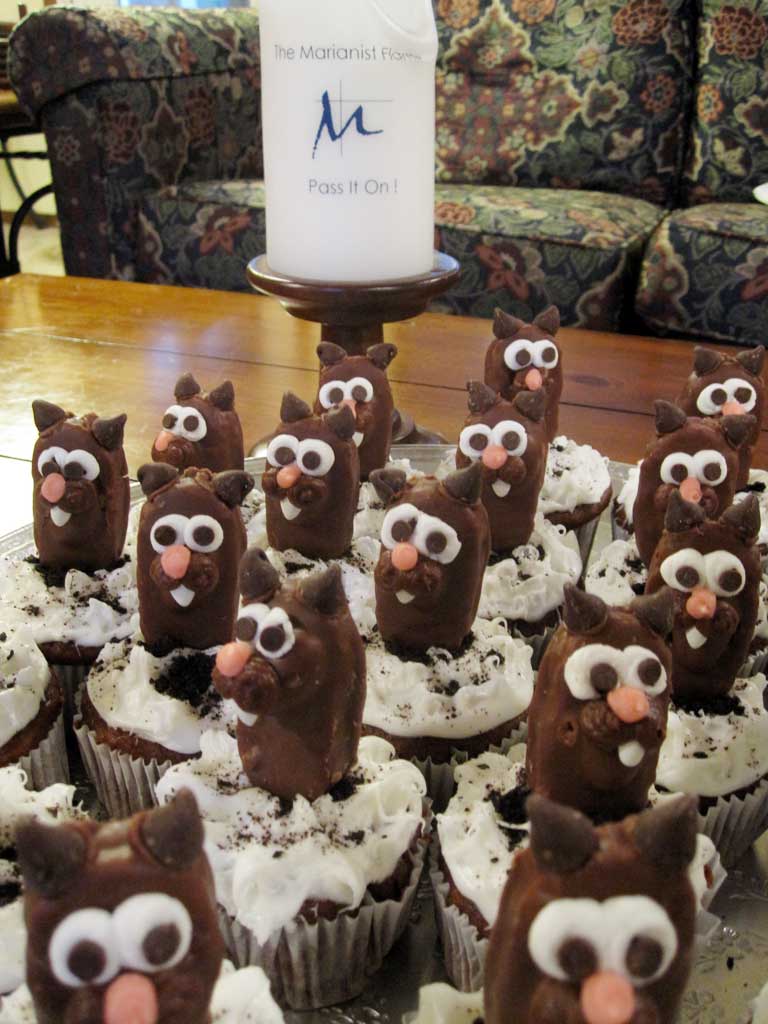
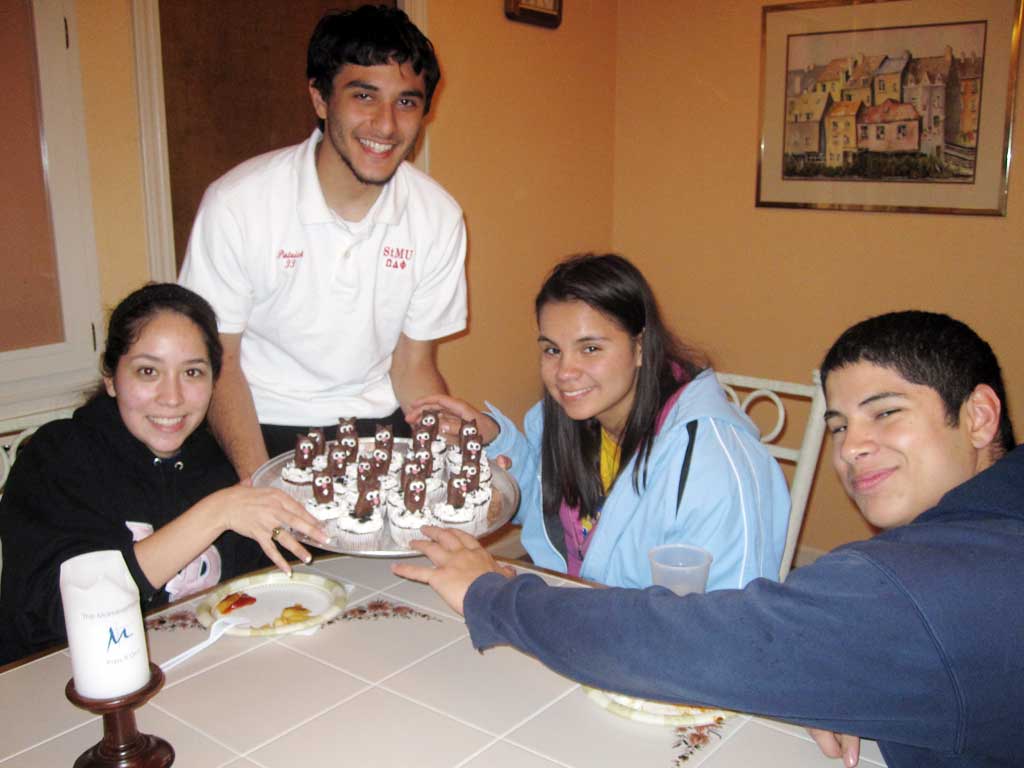
Casa Tuesday features ‘Groundhog Cupcakes’

Posted February 2, 2010 by casamariasm
Categories: Community News

To celebrate February 2nd, Casa Tuesday style, evening prayer recounted the first sodality of Bordeaux who made their commitments on this date in 1801 (read excerpt below). A simple supper followed with a special dessert: groundhog cupcakes!

Groundhogs (Almond Joy candy bar, Tic Tac tooth, chocolate chips and colored frosting) sit atop “Black Forest” flavor (German chocolate and cherry cola) cupcakes frosted in vanilla snow and crushed Oreo cookie dirt.

More photos on our Flickr set.

Evening Prayer Reflection:
On the feast of the Presentation of the Lord, February 2, 1801, Father Chaminade gathered with the first group of lay Marianists to profess their commitment to the mission of Mary in bringing about the presence of Jesus in the world.

Each member read the following words while laying a hand on the book of the Gospels:

I, servant of God, child of the Holy, Catholic, Apostolic and Roman Church, dedicate myself to the service of the blessed Virgin and to the cause of her Immaculate Conception. I promise to honor Mary under the title of Mother of Youth and to make her honored by others as much as is in my power. May God help me and may these holy Gospels give me strength.

Each one, beginning with Father Chaminade, himself, signed the Act of Consecration in Bordeaux, France, inside the small oratory of the Immaculate Conception. There were 12 of them and, like those first apostles of Jesus, represented a cross-section of society: teachers, students, a salesman, laborers, a shoe-maker, a manufacturer of playing cards, a cleric.

One of Father Chaminade’s favorite expressions, “Union without confusion,” was fulfilled. In a world where class distinctions were severely observed, the makeup of this group of 12 lay Marianists was, at that time, a revolutionary expression of equality in community—“a discipleship of equals.”

Within five years, this group grew in membership to a few hundred men and women.

By 1810, a number of young men and women of this group were looking for some form of religious life as Marianists.

In 1816, a handful of young women, including Adele de Batz de Trenquelleon, under the guidance of Father Chaminade and Bishop Jacoupy of Agen, inaugurated the group of religious sisters called the Daughters of Mary Immaculate (Marianist Sisters).

Similarly, in 1817, a group of men formed the first nucleus of a men’s religious order called the Society of Mary (Marianist Brothers and Priests).

Thus was the birth of the Marianist Family and its three branches—laity, sisters and brothers and priests.

(Adapted from Running Giant, by Louis Reile, S.M., page 61 and notes from the Handbook of Marianist History from NACMS, 2005; prepared at Casa Maria for vespers, Feb. 2, 2010)

Reflection: Presentation of the Lord

Posted February 2, 2010 by Hoahanau Malianika
Categories: Reflections

Mass: Tuesday, February 2, 2010
First Reading: Mal 3:1-4
Responsorial Psalm 24:7, 8, 9, 10
Second Reading: Heb 2:14-18
Gospel: Lk 2:22-40

February 2nd is a date that holds significant meaning for many throughout history. Despite the rich diversity of stories and events associated with this day, they all have one thing in common. Let’s see if you can figure what that is.

Imagine what it must be like for a young, teenaged girl to have her whole world turned upside down in the past year with the following experiences: being visited by a ghost who predicted many extraordinary things that are starting to come true; gotten pregnant out of wedlock knowing that is punishable by stoning; almost got dumped by her fiancee; finally got married while keeping the pregnancy secret to the public; setting out on a difficult road trip while about to give birth; finally having the child in a stink, smelly barn; having stranger visiting you and wanting to see your child—although some did bring wonderful gifts, which isn’t all that bad!; having to get up and move out of harms way; and now bringing this child to the temple, only to be told by an old man that more challenges await.

What keeps Mary going? What keeps her faithful? True, she has the big advantage of being born without sin, but what about Joseph? Imagine what he must be going through watching this unfold.

Perhaps there are enough lights of hope through all these difficulties—the visitation of the angel; the brightest star guiding the way; the affirmation of three kings and now these wisdom figures at the temple.

Fast forward several hundred years to the middle ages and another scene related to this date. We are now in eastern Europe. It is the dead of winter. Dark and stormy. No lights or electricity. At Church, beeswax candles are blessed and sent home and placed in the windows to ward off the storm and light up the home throughout the year. After all, it’s the feast known as Candlemas. Notice, once again, the symbol of light as protection, faith and hope.

Jump a few hundred years to 1801 in Bordeaux, France. A little French priest named William Joseph witnesses the commitment of a dozen lay people to the vision of Church as given to him by the Blessed Mother just a few years ago while on exile in Saragossa, Spain.

Although province directories and liturgy guides were yet to be invented, I imagine that light and candles were involved, somehow, as they professed their commitments to the Marianist way of life. Imagine what Chaminade must have felt as the candles were lit on this day—when only four years ago, he was banished from his own country on account of his faith.

We move a few years later, mid-1800s, into the new world, across the Atlantic ocean, to the United States. It is a cold, dark morning in the northeast. You awaken, wondering to yourself how much longer this cold, dark weather will last. You vaguely hear voices outside calling your name. As you rouse yourself out of bed, you see a faint glow of light. Excitedly, you run outside to see it is finally, a sunny day. All of a sudden, you see your shadow and run back inside your house. Unfortunately, there will be no early spring this year! You are Punxsutawney Phil, and the light of the sun is an important part of your life.

Finally, we move about 200 more years into the future, to south-central Texas—San Antonio, to be exact. We are gathered here at Mass in Casa Maria. The candle with the Marianist logo is lit, and it says, “The Marianist Flame: Pass it on.”

We are given the gift of a new day and another opportunity to be messengers of light. Fueled by the eucharist we are about to receive, let us pray that we use this day to honor the spirit of our founder’s vision by being and bringing Christ, the light of the world, to others.

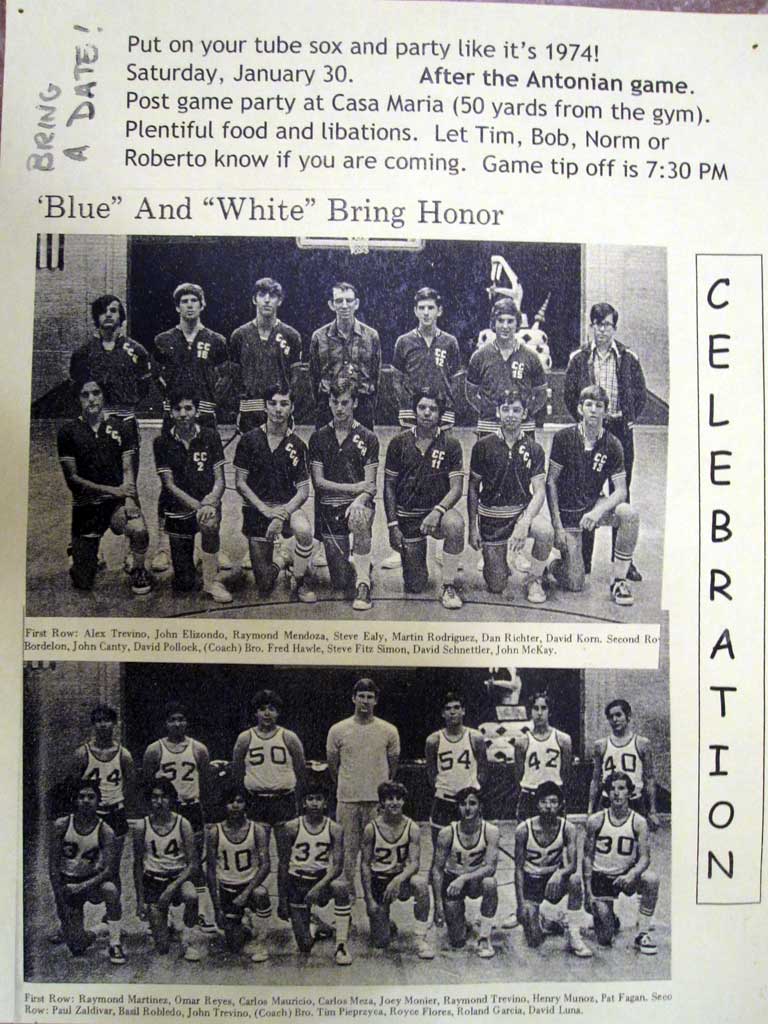
Casa María hosts CCHS post-game party

Posted January 30, 2010 by casamariasm
Categories: Community News

Tags: , , , , ,

About 30 faculty and staff from Central Catholic high school celebrated a basketball victory over Antonian Prep with a post-game party at Casa María. The game was held a few yards from the community at the Alumni Athletics and Convocation Center on the campus of St. Mary’s University. St. Mary’s alumnus and CCHS faculty member Jose Gonzalez conducted the interviews on video and served as the photographer.

More photos on our Flick set.

The invitation:

Reflection: 3rd Friday in Ordinary Time

Posted January 29, 2010 by mrcapinpin
Categories: Reflections

Mass: Friday, January, 29, 2010
First Reading: 2 Sm 11:1-4a, 5-10a, 13-17
Responsorial Psalm: 51:3-4, 5-6a, 6bcd-7, 10-11
Gospel: Mk 4:26-34

Musical excerpts in this reflection are from Leonard Cohen’s song, Hallelujah.

This first verse begins to describe the story of King David who was had an intimate relation with God and from his childhood was a talented musician. Pleasing the Lord could refer both to King Saul and literally the Lord.

David was blessed by God. After the mourning of Saul and winning the civil war, God promised David four things:

  1. That he would have a son to rule after him
  2. That his son would build the temple
  3. That the throne that occupied his lineage would be established forever
  4. And that God would never take His mercy from David’s house.

David truly wanted to follow God and was in turn blessed by God. But, we see in the first reading today that anyone can fall, even someone as blessed as him.

The second verse describes today’s reading of David and Bathsheba.

This story about David can be told in three simple sentences.

Walking on the roof of his house he saw a beautiful woman taking a bath. He sent and inquired about her. And then he took. In those three sentences you have a pretty good description of the processes of temptation. Any temptation in your life and mine could follow this pattern. It starts first with desire stirred in us simply because of human nature. There is nothing wrong with this but the desire is there, and it must be dealt with when it arises.

It can be dealt with properly at that point or it could be formed into something else. David saw the beautiful woman, desired her and then started to work out a way that he could take her. He sent and inquired about her. Then David, the one blessed by God, finds himself committing adultery. This weakened his relationship with God as we hear described in the song as the “broken throne.”

When it was accomplished, he refused to face the music, like so many of us try to do. Instead of openly confessing and acknowledging what he did wrong, and trying to make it right, he committed another sin to cover up. This is always the process of sin. If you commit one sin, you commit another to cover that one up, and then more to cover up the second one. And so on and so on as we later find David eventually responsible for murder. David’s sin with Bathsheba shows us how anyone can fall to temptation.

In a verse from Corinthians we read, “So, if you think you are standing firm, be careful that you don’t fall.” David’s sin with Bathsheba should be a warning to us that we need to be careful to not let our pride take over our spritual maturity and ability to withstand temptation in our own strength.

So, in preparing for today, as is my tendency, I focused completely on the Gospel first. Thoughts of middle school when I started my Catholic education were brought back. At that time we used this parable to describe something like love and goodness, and all the other fluffy stuff.

So, the other day when I shared the Gospel with a co-worker, I was totally confused with her take on it. She brought a different view on it that, at first, given the Gospel alone, made no sense.

She said, “Well, we’re planting seeds all the time. It’s the seeds you plant early in your life that will affect you later. In our younger years, we are trying to find who we are and that’s when we pant a lot of seeds. Sometimes we plant good seeds that turn into something beautiful and sometimes we plant seeds that come back to bite us. We don’t usually realize what we planted until were older.”

In my head, I was like, “What are you talking about?” I thought that she was totally off-base and that what she was saying was great; but, as far as an interpretation to the Gospel, she was really far from it. Now again at the time I hadn’t even looked at the first reading about David and Bathsheba, but later on in the day when I did, her words actually made some sense.

Tying the Gospel to the reading, I wonder what kinds of seeds David planted. Before he became king of Israel and Judah, what were those seeds that grew to eventually lead him to all of his triumphs. Also, what were those seeds that grew to eventually lead him to adultery with Bathsheba, the murder of Uriah, and all of the other troubles we find in the second half of the second book of Samuel.

This could be something we  could think about today. What are those tiny seeds that we are planting? Are these seeds, when fully grown, be ones that we will be thankful for or ones that will come back to bite us. What kinds of seeds will we plant today?